Most of us pick the format first. That’s the one decision that barely matters.
You’re probably one weekend away from making a PDF that nobody downloads.
I say that with love, because I’ve done it. More than once. You block out Saturday, you write forty pages, you find a cover template, you upload it… and then it sits there converting at almost nothing, and you assume the problem was that you should have made a video instead.
It wasn’t the format.
A lead magnet converts when it does one specific job for one specific person in under twenty minutes. Everything else (the file type, the page count, the design) is downstream of that.
So let’s build one that works.
The Short Answer
The lead magnet ideas for solopreneurs that convert in 2026 all pass the same test: can your reader finish it in one sitting and walk away holding something they didn’t have before?
Not “learn something.” Hold something. A filled-in page. A number. A verdict. A decision they’d been putting off for six weeks.
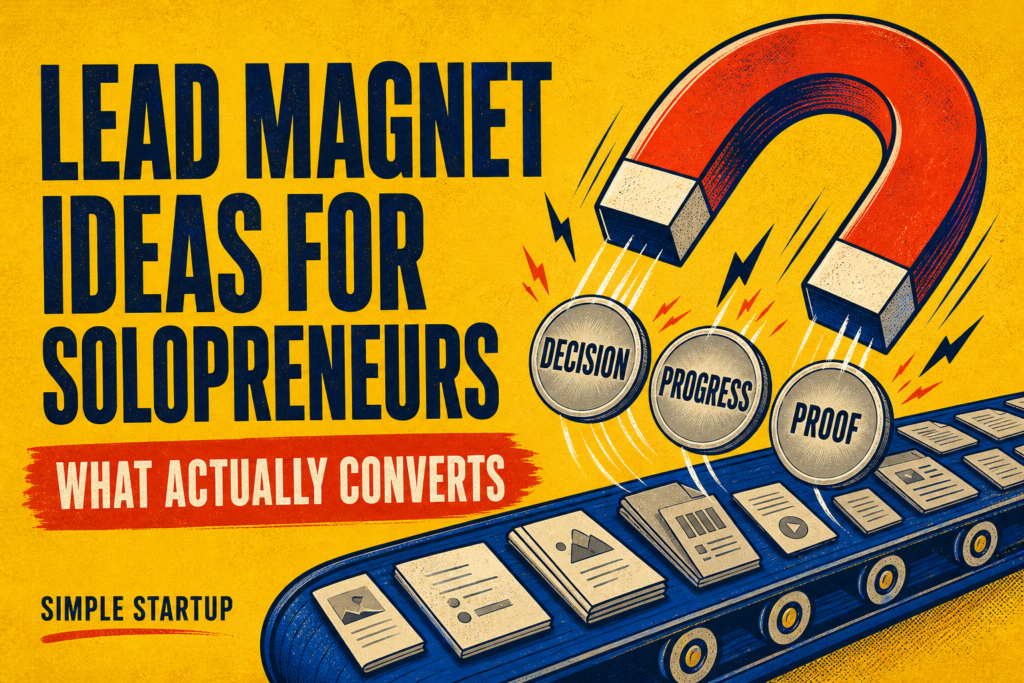
That’s the whole game, and it splits every good lead magnet into three jobs:
- Decide for me… a scorecard, a calculator, a one-page canvas. They finish it holding an answer.
- Do it with me… a checklist, a cheat sheet, a dated plan, a short challenge. They finish it holding progress.
- Show me it’s real… your receipts, your actual stack with prices, a short personal audit. They finish it holding proof.
Pick the job first. The format falls out of it almost automatically.
The Seven Things Every Good Lead Magnet Has
Before the ideas, the criteria. This is the part that decides whether an idea works, and it’s the part almost everyone skips. Which is why so many lead magnet ideas for solopreneurs look great on a list and convert like nothing in the wild.
A lead magnet worth building is:
- Highly specific. Not “grow your email list.” “The 6-email welcome sequence I send every new subscriber, with the exact subject lines.” Specific is the whole ballgame: vague offers get vague interest.
- High in perceived value. It has to look worth trading an email address for at a glance, before they’ve read a word of it. Design is not decoration here. It’s the promise.
- High in actual value. The moment someone opens it and thinks oh, this is thin, you haven’t gained a subscriber. You’ve spent one.
- Relevant to what you sell. If your magnet attracts people who will never buy what you offer, you’ve built a very efficient machine for growing a list that costs you money.
- Wrapped in a benefit-driven title. “Email Marketing Guide” is a filing label. “Get Your First 100 Subscribers Without an Ad Budget” is an offer.
- Easy to consume. Five to twenty minutes, start to finish. A 100-page ebook is not generous. It’s a chore with a bow on it.
- Instantly gratifying. It lands in their inbox in seconds and pays off in the first thirty of them.
Read your idea against those seven right now. If it fails three or more, don’t build it… the design work will not rescue it, and I say that having tried.
The One Thing That Has Changed
Here’s what’s different in 2026, and it only takes a paragraph.
Your reader has ChatGPT open in the next tab, and it doesn’t ask for their email address. The second they suspect your magnet is general information about a topic, they type the question there instead and get a version personalized to them in twelve seconds.
Information isn’t scarce anymore. Judgment, specificity, and proof still are.
Which doesn’t kill the criteria above. It sharpens one of them. “High actual value” now means value your reader’s AI genuinely can’t produce for them: your numbers, your ordering, your opinion about what to skip.
Keep that in your head as you read the next section.
Lead Magnet Ideas for Solopreneurs, Grouped by the Job They Do
Job 1: Decide for Me
These are the highest-converting magnets a solopreneur can build, because the thing your reader is short on isn’t information. It’s a decision.
The one-page canvas. Not a template they download and never open… a page with boxes, where the boxes ask uncomfortable questions. I built one called the Simple Startup Canvas, the companion to my post on how to write a business plan for solopreneurs. Fifteen pages, one question per page, fillable fields right in the PDF so you can type into it instead of printing it.
It took four design rounds before I’d ship it:
- Round one… clean, professional, completely generic. Looked like every template on Etsy.
- Round two… the real canvas, but every page was crammed. My own brain shut down looking at it.
- Round three… bold, loud, big color blocks. Better, still busy.
- Round four… one box per page, white space, big type. That’s the one that made me think okay, I’d actually fill this out.
The design work was the product work. A canvas nobody wants to look at is a canvas nobody completes, and a canvas nobody completes never turns into a customer.
The scorecard. Twelve questions, each answer scores, and at the end there’s a number and a sentence explaining it. “You scored 31 out of 60. Your positioning is clear, but nothing on your site says who it’s not for.”
That sentence is the product. Anyone can write twelve questions. The scoring logic is your judgment, encoded. It’s the part that took you nine years to learn and takes them ninety seconds to borrow. And people screenshot their score and share it, which no PDF has ever done.
The calculator. A spreadsheet with three inputs and one big output cell. “How many subscribers do I need before a $47 product is worth building?” They type in their list size, their open rate, their conversion rate, and the bottom of the sheet tells them: 1,900, or raise your price.
Nobody screenshots a paragraph. Everybody screenshots a number. Better still, a calculator can’t be consumed passively… they have to type their own reality into it, which means they’re now standing inside your framework.
Job 2: Do It With Me
These are the classics, and they still work, as long as they’re built to be finished.
The checklist. The fastest lead magnet in existence and still one of the best converters, because it’s pure sequence with no filler. The trap is making it generic. “Social media checklist” is dead on arrival. “The 9 things I check before publishing any post, in order” is not.
The cheat sheet. One page, reference-style, meant to live next to their keyboard. Jon Morrow’s 52 Headline Hacks is around fifteen years old and still gets traded around, because a cheat sheet doesn’t expire the way a guide does.
The dated plan. This is the upgrade on the old “action plan,” and the difference is worth the whole section. Compare:
- A topic list… “Week 1: audit your site. Week 2: fix your titles.” Reads fine, gets abandoned by Thursday.
- A dated plan… “Day 1 (Monday): open your five best posts, paste each title into Google, write down what ranks above you. 25 minutes.” Gets done.
The second one made the decisions: what to do, in what order, for how long, starting when. My 90-Day AI Visibility Action Plan is built that way on purpose… every line carries a day number and a time estimate. Every decision you leave in the plan is a decision your reader has to make while tired, and most of them won’t.
The short challenge. Five days, one small action a day, delivered by email. The reason challenges convert is that they create a streak, and a streak creates a relationship. Keep the daily action under fifteen minutes. And know the tradeoff going in: a challenge is the one magnet on this list that trades instant gratification for depth, so only reach for it when the transformation genuinely needs a few days.
The worksheet. A canvas’s smaller cousin. One exercise, one page, one output. Perfect when your reader’s problem is narrower than a whole business plan: defining an ideal customer, pricing one offer, writing one page of copy.
Job 3: Show Me It’s Real
This is the group most solopreneurs never build, and it’s the one where you have an unfair advantage over every big brand in your niche.
Your receipts, not your advice. Not “how to run an experiment”… your experiment. The actual prompts, the actual answers, the actual moment it didn’t work. I ran a test where I asked ChatGPT to recommend a business like mine and it never mentioned my site once, even though it clearly knew the site existed. It quoted a phrase I invented straight back at me.
That negative result is worth more than a guide, because no model can generate it. It only happened to me. Your failures are proprietary data. Package them.
Your actual stack, with the prices you actually pay. Not “15 Best Tools for Solopreneurs”… that post exists ten thousand times over. This instead: the seven tools you pay for, what each costs per month, what you tried before it, and the one you’re about to cancel and why. I run this site on WordPress with the Bricks builder, FluentCRM for email, and a team of Claude agents doing the busywork, and I wrote up the whole setup for running a one-person business with AI precisely because that combination isn’t on anyone’s listicle.
The 15-minute personal audit. The one that doesn’t scale, which is exactly why it works. They send a URL, you send back a two-minute screen recording with three things you’d change. No calendar link, no discovery call, no pitch. Cap it (“first five each week”) and if you’re a solopreneur with 200 subscribers, those five conversations aren’t a bottleneck. They’re your entire research department.
Three to Skip
So you don’t lose a weekend:
- The 100-page ebook. It fails “easy to consume” so badly that nothing else can save it. Nobody has ever finished yours. I promise.
- The 500-prompt pack. Five hundred prompts isn’t a gift, it’s homework. Ten opinionated prompts with your notes on when each one fails… that one still works.
- The open-ended “free consultation.” Asking a stranger for thirty minutes four seconds after they met you inverts the trade. You’re the one asking for something. The capped 15-minute audit above is the version that converts.
The Title Is Half the Conversion
Your magnet can be excellent and still die at the headline, so give this ten minutes rather than ten seconds.
Weak titles describe the file. Strong titles describe the reader’s situation on the other side of it.
- Describes the file… “Email Marketing Checklist.” “Business Planning Worksheet.” “SEO Guide.”
- Describes the outcome… “The 9 Things I Check Before Publishing Any Post.” “Your Whole Business Plan on One Page, in 20 Minutes.” “Get Found by AI Search in 90 Days, 25 Minutes a Day.”
Notice what the strong ones do. They put a number in (specific), a time cost in (easy to consume), and an outcome in (benefit-driven). That’s three of the seven criteria doing their work before anyone has clicked anything.
Build One This Week
Most posts about lead magnet ideas for solopreneurs stop at the ideas, which is the easy part. Here’s the honest sequence, because we all stall at the same step and it isn’t the one you’d guess.
Day 1: pick the decision, not the topic. Open your last ten client conversations or DMs and find the question people ask right before they get stuck. That’s your magnet. Mine was “what do I even put in a business plan when I’m one person?”
Day 2: make it ugly and complete. One page in a doc, all the questions, no design at all. If the ugly version doesn’t feel useful, design will not save it. Round one of my canvas was proof of that.
Day 3: design it like you’d sell it. Big type, one idea per page, generous white space. If your reader’s brain shuts down on page one, the other fourteen pages don’t exist.
Day 4: wire the delivery. This is where it actually dies for most people, so it gets its own section below.
Day 5: put it on the post it belongs to. Not the sidebar, not the footer. Inline, inside the article about the exact problem it solves, plus one polite popup once they’ve scrolled a third of the way down.
Five days. Realistically two evenings, if you can resist redesigning it four times because you can’t leave it alone.
The Delivery Machine, Where Most of Them Break
I wired the Canvas funnel end to end recently and tested it with a real signup. Here’s the whole chain with the actual tools, because seeing it written out is what makes it stop feeling complicated:
- A form on the post. Mine is Contact Form 7: one field, email only. Every extra field costs you signups.
- A tag applied on submit. The form submission applies a tag in FluentCRM, so you know later which magnet brought this person in. This is your entire segmentation strategy in one step.
- An automation that fires on that tag. A FluentCRM automation that exists to send exactly one email.
- The delivery email, instantly. The subject line says what’s inside, the body has one button. No newsletter, no bio, no six paragraphs about your journey.
- A tracked link on the button. I use Pretty Links, so I can count downloads instead of guessing.
- A thank-you page with the file on it too. Because some people will never find the email, and you’ll never know which ones.
Then (and this is the step everyone skips) sign up for your own thing. Real email, real click, real download. I found a broken redirect on mine that way. It pointed at the wrong page and would have quietly failed for every single subscriber.
A lead magnet that doesn’t arrive isn’t a lead magnet. It’s an apology you’ll be writing later.
I don’t have conversion numbers on the Canvas yet, and I’m not going to invent any. It’s newly live. I’ll report what actually happened in 90 days, including if the answer is “barely anyone downloaded it.”
One more reason to take this seriously.
When I went through all 46 posts on this site recently, exactly one had a working in-content opt-in. One. My best-ranking post, sitting at #4 in Google, was collecting emails through a form wired to ActiveCampaign… an account I’d stopped paying for.
I’ve written plenty about the getting-found half of this: SEO for solopreneurs, and how AI search optimization for small business lets small sites beat big brands.
None of it counts if the offer at the end doesn’t work.
Free worked example
Get the Simple Startup Canvas
Want to see one of these built properly before you build yours? The Canvas is the one-page business plan I actually use: fillable, free, and a working example of all seven criteria in this post.
Plus one practical idea a week for your one-person business. No spam. Unsubscribe anytime.
Before you go… it’s free
Don’t just read about lead magnets. Hold one.
Grab the Simple Startup Canvas: the fillable one-page business plan from this post’s case study, and a working example of everything you just read.
One practical idea a week. No spam. Unsubscribe anytime.
The Part Worth Remembering
Producing things is free now. Anyone can generate a forty-page guide before their coffee cools.
Which means the value of anything you make has moved almost entirely into the decisions you made while making it: what to leave out, what goes on page one, which question to ask third, what you’re willing to admit didn’t work.
That’s not a format. You can’t pick it off a list.
It’s the part of you that ends up inside the file… and it turns out that was always the only part anyone was paying attention to.
So pick the one question your people get stuck on. Build the ugly one-page version tonight. Ship it before you’re proud of it.
And if you want the bigger kit, the Free Startup Toolkit has the templates, tools and AI workflows I use to run this whole business solo.
FAQ
What are the best lead magnet ideas for solopreneurs with a small audience?
The 15-minute personal audit, almost every time. Under about 1,000 subscribers your constraint isn’t scale, it’s learning what people actually want… and a handful of real conversations a week teaches you more than a thousand anonymous downloads. Cap it at five per week so it stays sustainable.
What makes a lead magnet convert?
Seven things: it’s highly specific, high in perceived value, high in actual value, relevant to what you sell, wrapped in a benefit-driven title, easy to consume in under twenty minutes, and delivered instantly. Miss three of those and the format won’t save it.
Do lead magnets still work in 2026?
Yes, but the trade changed, and so did the lead magnet ideas for solopreneurs that are worth building. People no longer swap an email address for information, because information is free and instant. They’ll still swap it for a decision, a verdict, a tool, or proof they can’t get anywhere else.
How long should a lead magnet be?
Short enough to finish in one sitting: in practice, five to twenty minutes of your reader’s time. One well-designed page that gets completed beats a 40-page guide that gets downloaded and forgotten. Completion is the metric, not length.
Should I use AI to create my lead magnet?
Use it for production: layout, formatting, first drafts, building the file. Don’t use it for the judgment. If Claude or ChatGPT could generate your entire magnet from a one-line prompt, so can your reader’s AI, and they don’t have to give up an email address to do it.
How many lead magnets should I have?
Start with one, attached to your best-performing post. Add a second only once the first is delivering reliably and you know which post it converts on. Most solopreneurs would be better off with one great magnet on five posts than five mediocre magnets on one.
Where should the opt-in go on the page?
Inline, inside the article that discusses the exact problem the magnet solves, roughly a third to halfway down. Sidebar and footer forms are close to invisible on mobile. One well-timed popup after a scroll trigger is fine… two is a tax on your reader.