I’ve been playing the SEO game for almost a decade.
I remember when the formula actually worked. Pick a keyword. Write the post. Build a few links. Wait three months. Watch the traffic climb. It was slow, but it was predictable… like planting a garden where the seeds always sprouted.
Then last year, I started seeing the same message everywhere. In Facebook groups, on X, in every marketing newsletter I’m subscribed to: “SEO is dead.” Traffic graphs falling off cliffs. Bloggers posting screenshots of analytics dashboards that look like ski slopes. People who spent years building content businesses wondering if any of it still matters.
If you’ve watched your own traffic shrink and felt that quiet panic… you’re not alone. The numbers behind the panic are real.
But the conclusion is wrong.
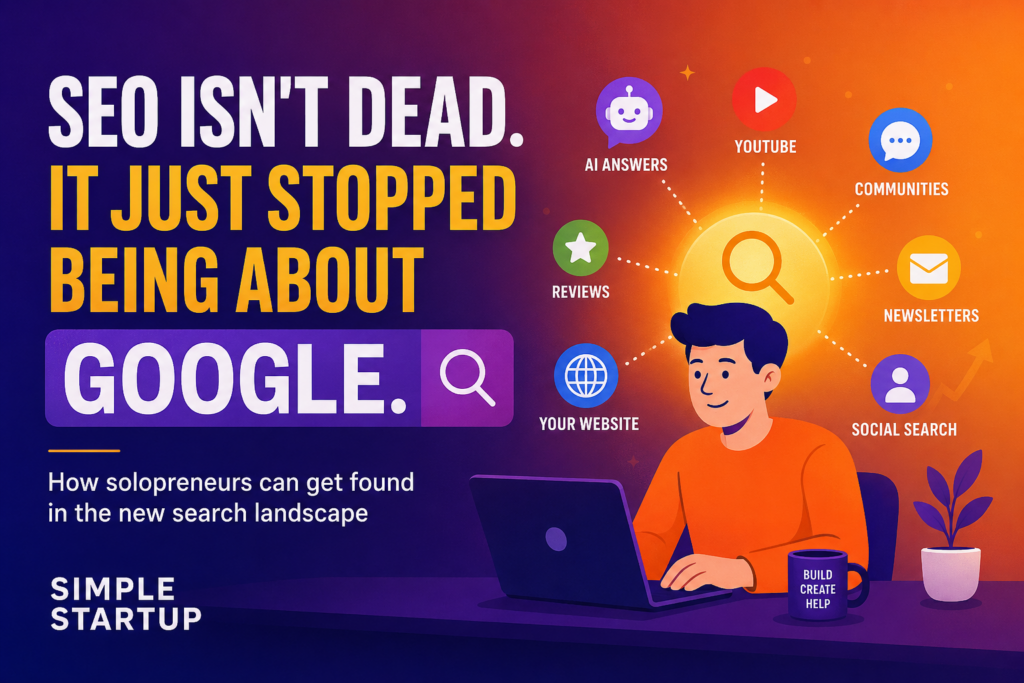
SEO isn’t dead. It just stopped being about Google. And SEO for solopreneurs in 2026 looks nothing like the game we were taught… which is the best news in years, if you understand what actually changed.
In this post I’ll show you what the data really says, why small sites suddenly have the edge, and a concrete 90-day plan you can start this week.
1. The Numbers Behind the Panic Are Real (But Misread)
Let’s start with what’s true, because I’m not going to pretend the ground didn’t move.
As of early 2026, roughly 68% of Google searches end without a single click to any website. Someone types a question, Google’s AI Overview answers it right there on the page, and the searcher leaves. No visit. No pageview. No chance to earn a subscriber.
Read that again: two out of three searches never send anyone anywhere.
If your content strategy was “rank for informational keywords and collect the traffic”… that machine is broken. The listicle that pulled 10,000 visits a month in 2022 might pull 2,000 now, not because it got worse, but because the answer gets served before the click.
Here’s what the panic-merchants leave out, though. People didn’t stop searching. They didn’t stop looking for tools, comparing options, or asking “what’s the best way to start an online business.” Search demand didn’t shrink.
It relocated.
2. Search Didn’t Die. It Moved Into the Chat Window.
Think about how you found the last tool you paid for.
If you’re like most of the solopreneurs I talk to, there’s a decent chance you didn’t Google it at all. You asked ChatGPT. Or Claude. Or Perplexity. You described your situation… “I’m a one-person business, I need something simple for email”… and the AI gave you three names and a recommendation.
That’s a search. It just doesn’t look like one in anyone’s analytics.
The scale of this shift is easy to underestimate because each AI referral is invisible until someone clicks through. But the data coming out of 2026 is hard to ignore: AI-referred traffic to online stores grew almost 400% year-over-year in the first quarter of this year. Shopify saw AI-referred sessions grow about 8x in fourteen months… and orders from those sessions grow 13x.
Those are retail numbers, not blog numbers, so hold them loosely. Your niche will look different. But the direction is unmistakable: a growing slice of your future readers and customers will meet you inside an AI answer before they ever see your website.
Which raises the only question that matters: when someone asks an AI for a recommendation in your niche… do you come up?
For most small sites, the answer right now is no. Not because the AI rejected you. Because it doesn’t know you exist. That’s not a traffic problem. That’s a visibility problem, and it’s fixable.
3. The Traffic You Do Get Is Worth More Than Ever
Here’s the part of the story almost nobody is telling, and it’s my favorite part.
The visitors who do click through from an AI answer behave completely differently from old-school search traffic. Adobe’s data from March 2026 shows AI-referred visitors now convert 42% better than regular traffic. They spend nearly half again as long on site. They browse more pages. Shopify’s numbers say AI-referred sessions convert around 50% higher on product pages.
Why? Because they arrive pre-sold. They already had the conversation. They already compared the options, asked the follow-up questions, and narrowed it down… inside the chat. By the time they land on your site, they’re not browsing. They’re confirming.
A year earlier, AI traffic converted worse than average. Now it converts better. That flip happened in about twelve months. Caveats apply, as always… these are aggregate numbers, early days, and your results will vary. But the pattern matches what I see with my own audience: fewer visitors, better visitors.
This changes the math for a one-person business completely.
The old game was volume: rank for everything, funnel thousands of strangers through your site, convert 1-2%, live with the churn. The new game is being the answer: show up when it matters, for the person who’s already halfway to a decision.
You don’t need 50,000 visitors a month. You need the right 500.
That’s it. That’s the reframe. And a one-person business is the perfect size to win that game.
4. Why Small Sites Have the Advantage Right Now
This is going to sound contrarian, but I mean it: for the first time in a decade, being small is a structural advantage in search.
Think about what an enterprise site has to do to adapt to AI search. Committee meetings. Brand guidelines. A CMS migration project with a six-month roadmap. Fourteen stakeholders arguing about whether FAQ schema is “on brand.” By the time they’ve approved the plan, the landscape has shifted twice.
You? You can restructure your entire site this week.
You can rewrite a post so it answers the exact question people ask AI assistants. You can add an FAQ to every important page. You can clarify who you are, what you do, and who you serve so plainly that a language model can’t misunderstand it. Tonight, if you want.
AI systems don’t rank you by domain authority the way 2015 Google did. They pull from content that’s clear, structured, specific, and trustworthy… whoever wrote it. A focused post by a solo founder who actually did the thing routinely gets cited over a 4,000-word corporate content-mill piece that says nothing.
Speed and clarity beat size. When has that ever been true in SEO before? I’ve since made the complete case, with the receipts… see AI search optimization for small business.
5. What Still Works (The Boring Survivors)
Now, before you burn your SEO playbook… don’t. About half of it survived, and it happens to be the half that was always the real work:
- Search intent still rules. Understanding what someone actually wants when they ask a question is the whole game, whether the “search engine” is Google or ChatGPT.
- Clear structure wins. Descriptive headings, direct answers near the top, one idea per section. AI systems parse structure the way skimming humans always did… they just never get tired.
- Proof beats polish. First-hand experience, real numbers, honest caveats. AI models are increasingly tuned to surface content with evidence of actual experience behind it. “I tried this and here’s what happened” is now a ranking factor in everything but name.
- Internal links still matter. They teach both crawlers and AI systems what your site is about and what belongs together.
- Email is still the endgame. More on this in a second.
What’s dead is the junk food: chasing high-volume keywords you have no business ranking for, thin listicles written for bots, publishing five mediocre posts a week and calling it strategy. If I’m being fair… that stuff was never really alive. It just took an algorithm shift to expose it.
6. The 2026 SEO Playbook for Solopreneurs
So what do you actually do? Here’s the version I’m applying to my own site, in order:
First, make your content answer-shaped. Every important post should answer a specific question a real person would ask an AI assistant, clearly, near the top. Then go deep. I’ve broken down the mechanics of this in my guide to AI Search Optimization (GEO & AEO) if you want the full walkthrough.
Second, make yourself impossible to misunderstand. An AI can only recommend you if it can figure out what you are. One sentence, on every key page: who you help, what you help them do, what makes you different. If a language model can’t summarize your business, it can’t cite your business.
Third, add an FAQ to pages that matter. Real questions, direct answers, a few sentences each. This is the lowest-effort, highest-leverage change on this list… it hands AI systems exactly the format they love to quote.
Fourth, be present where the models read. AI systems learn from across the open web, not just your domain. A thoughtful answer in a niche community, a guest post, a genuinely useful thread… each one is another place an AI can learn you exist. This is why I’ve gone back to publishing consistently, everywhere, with AI agents handling the production busywork so it doesn’t eat my week.
Fifth… and this is the one that matters most… convert visibility into ownership. Every channel in this post is rented. Google was rented. ChatGPT is rented too, and the rent will go up. The only audience you own is your email list. When that pre-sold AI visitor lands on your site, the single most important thing they can do is not “read another post.” It’s leave you their email address, so the relationship stops depending on an algorithm… any algorithm.
Traffic is a tactic. The list is the asset. That was true in 2016 and it’ll be true in 2036.
7. Your First 90 Days: The Actionable Plan
Principles are nice. Here’s what I’d actually do, in order, if I were starting today. None of this needs a budget… just a few focused hours a week.
Days 1–7: Find out where you stand.
- Ask ChatGPT, Claude, and Perplexity to recommend a business like yours. Screenshot what comes back. That’s your baseline.
- Open Google Search Console and list your top 10 pages by impressions. These are the pages worth fixing first.
- Write your one-sentence positioning: who you help, what you help them do, what makes you different. You’ll use it everywhere.
Days 8–30: Fix what already exists.
- Rewrite your top 5 pages so the core question gets a direct answer in the first two or three sentences… then go deep below it.
- Add an FAQ section (3–5 real questions, plain answers) to each of those pages.
- Put your positioning sentence on your homepage, about page, and author bio. If an AI can’t summarize you, it can’t recommend you.
- Check the boring stuff once: pages load fast, mobile works, nothing important is blocked from crawling.
Days 31–60: Publish answer-shaped content.
- Pick 4 questions your ideal customer actually asks an AI assistant… not keywords, questions. Write one post per week that answers each one better than anyone in your niche.
- Interlink them, and link each back to your most relevant page. Give every post one job and one CTA… for most solopreneurs, that CTA is your email list.
- Repurpose each post where your audience already hangs out: a thread, a LinkedIn post, an answer in a niche community. Every mention is another place AI systems can learn you exist.
Days 61–90: Measure and double down.
- Re-run the Day 1 experiment. Do the assistants know you now? Even a partial mention is progress… this compounds over months.
- In Search Console, find the queries where you rank on page two. Those are your cheapest wins… improve those pages first.
- Check your email signup rate, not just traffic. If 1,000 visits produced zero subscribers, fix the capture before writing anything new.
- Keep the weekly publishing rhythm. Consistency is the entire moat.
That’s it. No tricks, no tools you have to buy. Ninety days of this puts you ahead of most sites in your niche… because most sites are still optimizing for an internet that’s already gone.
Free interactive workbook
Get the 90-Day AI Visibility Action Plan
Everything in this post, turned into a fill-in workbook: the checklists, the 6-prompt library, the worksheets, and a 12-week tracker. Type in it, click the checkboxes, save your progress.
Plus one practical idea a week for your one-person business. No spam. Unsubscribe anytime.
The 90-Day
AI Visibility
Action Plan
Checklists, worksheets, and copy-paste prompts. Get found by Google and ChatGPT.
Before you go… it’s free
Turn this post into your 90-day plan
The interactive workbook version: checklists, the 6-prompt library, worksheets, and a 12-week tracker. Fill it in right on your screen.
One practical idea a week. No spam. Unsubscribe anytime.
The 90-Day
AI Visibility
Action Plan
Checklists, worksheets, and copy-paste prompts. Get found by Google and ChatGPT.
The Bigger Picture
Here’s what I keep coming back to.
We were never actually in the “ranking on Google” business. That was just the road, and for fifteen years it was the only road, so we confused it with the destination. The actual business was always the same: be findable and trustworthy at the moment someone needs what you do.
Google changed the toll booth. AI moved the road. The destination didn’t move an inch.
Every platform shift feels like a catastrophe to the people optimized for the old platform and like an open door to the people willing to walk through it early. Most of your competitors are still refreshing their Google Search Console and mourning. The door is standing wide open.
So here’s your small step for today… it takes two minutes. Open ChatGPT and ask it to recommend a business like yours. Your niche, your kind of offer. See if you exist.
Whatever answer you get, you’ll know exactly where you stand. And now you know what to do about it.
Want the tools I use to act on this? The Free Startup Toolkit has the templates and AI workflows I’d start with. And if you want one practical idea like this every week, join the newsletter… it’s free, and you’ll get the Simple Startup Canvas with it.
FAQ
Is SEO still worth it in 2026?
Yes… but not the 2019 version of it. Chasing informational keyword volume is mostly a losing game now that AI Overviews answer those queries directly. What works is intent-focused, answer-shaped content that both Google’s AI features and assistants like ChatGPT can understand and cite. Think fewer, better pages built around questions your actual customers ask.
What is AI search optimization (GEO)?
Generative Engine Optimization is the practice of making your content easy for AI systems… ChatGPT, Claude, Perplexity, Google’s AI Overviews… to find, understand, and cite when they answer questions in your niche. It overlaps heavily with good classic SEO: clear structure, direct answers, demonstrated experience, and consistent presence across the web.
How do I get my website recommended by ChatGPT?
There’s no submission form and no shortcut. AI assistants recommend businesses they’ve encountered in their training data and live web results, described clearly enough to summarize. Practically: state plainly who you serve and what you do, structure content around real questions, add FAQs, earn mentions on other sites, and keep your pages crawlable. It compounds over months, not days. For the complete process, read my step-by-step guide on how to get your business recommended by ChatGPT.
Should I stop writing blog posts?
No. But stop writing them for a 2019 algorithm. Every post should do at least one of three jobs: answer a question your ideal customer asks an AI, demonstrate first-hand experience that builds trust, or move a reader onto your email list. If a post idea does none of those… skip it.
What’s the best SEO strategy for solopreneurs in 2026?
Three moves, in order: make your existing content answer-shaped so both Google and AI assistants can cite it, show up consistently in the communities and platforms where your audience already spends time, and convert every visitor you can onto an email list you own. Volume-chasing is out. Being the clear, trusted answer for a specific niche is in… and the 90-day plan above is the fastest route there.
