For the first time in twenty years, being small is a structural advantage in search. Most small business owners haven’t noticed yet.
For most of my decade in SEO, the honest advice for small websites was humbling: don’t pick fights you can’t win.
Want proof? Search “lead magnet ideas” right now. Page 1: HubSpot, Mailchimp, OptinMonster. It’s looked that way for years, and no one-person site was ever going to crack it. Domain authority was a moat, the moat took years and money to dig, and the big brands had both.
So we played the corners. Stayed out of the open field.
Then this week, something strange happened.
I was researching keywords for my own posts, checking page 1 for AI-search queries… and the giants weren’t there. Page 1 for “how to get your business recommended by ChatGPT”? Small agencies, indie tools, one press release. The small-business version of AI search optimization? Six boutique shops you’ve never heard of.
No HubSpot. No Ahrefs. No Forbes.
The open field is empty. Most small business owners haven’t noticed yet.
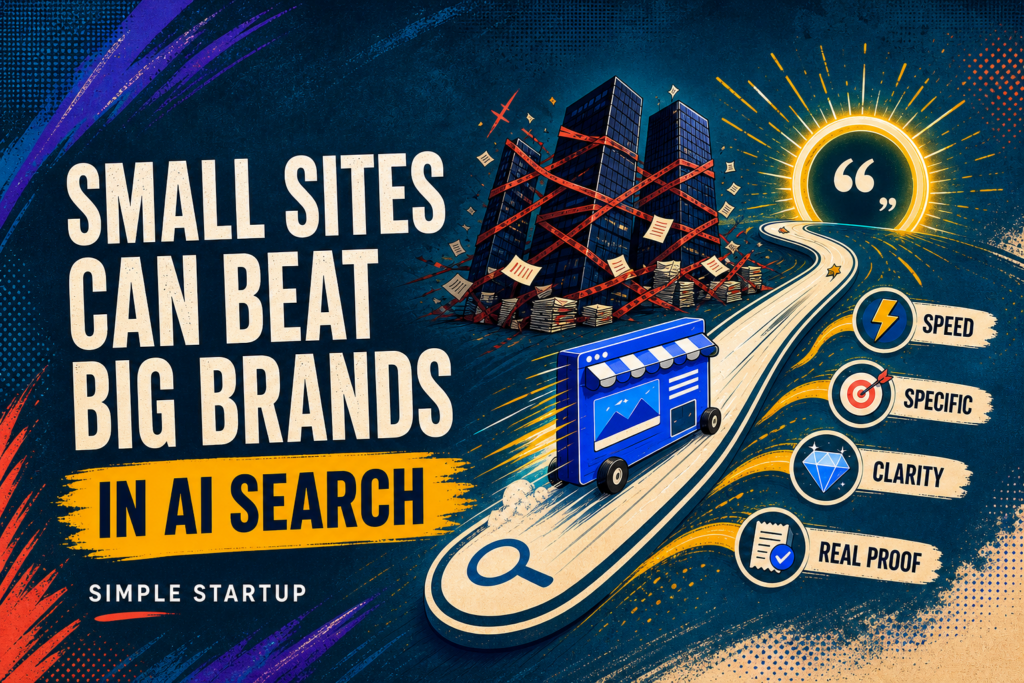
So let me make the case I only hinted at in my SEO post, and prove it properly this time: in AI search, small sites don’t just survive.
Played right, they win.
AI Search Optimization for Small Business: The Short Version
If you only take one thing from this post, take this: AI search rewards clarity, specificity, speed, and first-hand experience… four things a small business has naturally and a big brand has to fake.
The practical plan:
- Claim new questions early… nobody owned “how do I get recommended by ChatGPT” in 2022, because nobody was asking it.
- Be the specialist… AI quotes the exact answer (“pricing for first-time course creators”), not the biggest name.
- Publish first-hand receipts… “here’s the experiment I ran and what happened” gets cited; “10 tips for growth” doesn’t.
- Make your entity unmistakable… one sentence a machine can’t misread: who you help, with what, and why you.
- Move weekly… you ship changes tonight; they schedule a meeting about it.
The rest of this post is why each of these works, with what I’ve seen on my own site this month as evidence.
1. The Old Moat Doesn’t Transfer (Yet)
Here’s the thing about domain authority: it was a moat built for a specific castle.
Google’s link graph rewarded age, backlink mass, and brand weight, compounding for two decades. That’s why “lead magnet ideas” belongs to HubSpot and “sales funnel” belongs to whoever spent the most years and dollars on it.
AI answers don’t inherit that moat wholesale.
When ChatGPT or Perplexity assembles an answer, it’s not running PageRank. It’s looking for content that directly, clearly, and credibly answers the question… and for names it has seen associated with the topic. Some of the old signals still help.
But the compounding head start? Largely reset for anything new. And new questions have no incumbents.
Questions like these barely existed two years ago:
- “How do I show up in Google’s AI Overviews?”
- “Can ChatGPT recommend my Etsy shop?”
- “What’s the best AI agent setup for a solo coach?”
- “Why doesn’t Perplexity cite my website?”
Nobody owns those yet. Every month, AI adoption mints thousands more like them… and the first site to answer one well becomes the source AI engines learn from.
This month, that was me on a couple of queries. Next month it could be you in your niche.
The window won’t stay open. The big brands are slow, not stupid. Which brings me to the second advantage.
2. Speed Is a Structural Advantage, Not a Hustle Slogan
Think about what it takes for an enterprise to adapt its website to AI search. A committee meets. Brand guidelines get consulted. Legal reviews the FAQ copy. A CMS ticket enters a six-month roadmap.
I’m not exaggerating. I’ve sat in those meetings as the consultant… I once watched a two-hour discussion about a meta description.
Now think about what it takes you.
An evening.
Here’s what one week of “small” actually looks like:
- Tonight: rewrite your homepage headline so it says who you help in one sentence.
- Tuesday: add a 4-question FAQ to your services page.
- Thursday: fix your About page so a language model can’t misunderstand you.
- Friday: publish the answer to a question a customer asked you this week.
That’s a full AI-search overhaul. Their version of that list has a Q4 budget review attached.
In stable environments, size wins. In shifting environments, speed wins.
Search hasn’t shifted this much since Google killed the directory era. Speed is worth more right now than it has been in twenty years, and it’s the one asset where you’re not the underdog.
3. AI Quotes Specialists, Not Generalists
Watch what happens when someone asks an AI a real question: “How should I price my first digital product as a coach?”
There are two candidate answers on the web.
Answer A: a 4,000-word “Pricing Strategies for Businesses of All Sizes” guide from a big brand. Written for everyone, reviewed into blandness, committed to nothing.
Answer B: a post by a coach who priced three products, showed the numbers (“my $27 workbook outsold my $199 course 11-to-1”), and admitted what flopped.
The AI quotes B. Every time it can find a B.
Content written for everyone is quotable by no one. That’s the structural problem big brands can’t fix without becoming small.
And it’s why niching down… the advice you’ve heard a hundred times for positioning… is now a search strategy too. My posts don’t compete on “SEO.” They compete on “SEO for solopreneurs,” and that qualifier is why a one-person site holds its own on page 1.
The narrower the question, the more the specialist wins.
And AI search is made of narrow questions.
4. First-Hand Experience Is the New Domain Authority
Here’s the pattern I keep seeing in what AI engines actually cite: evidence of someone who did the thing.
What does that look like in practice?
- Real numbers… not “email marketing works,” but “my welcome email gets a 62% open rate.”
- Own screenshots… your actual dashboard, not a stock image.
- A documented experiment… “I asked ChatGPT to recommend a business like mine. Here’s exactly what it said.”
- An honest caveat… “this worked for me, but my list is small. Yours may differ.”
Generic advice has none of those. That’s why it never gets cited… it now costs nothing to produce, so it’s worth nothing to quote.
A big brand can buy backlinks. It can’t easily fake having done the thing as one person.
You can.
Yesterday I published that exact experiment… my real prompts, my real (humbling) results. Nobody else could have written that post, which is precisely what makes it citable.
Your version exists too. The client project that went sideways. The pricing test you ran. The tool comparison you actually paid for.
Domain authority took years and money. Experience authority takes honesty and a screenshot.
That trade favors you.
5. You Can Be Unmistakable. Conglomerates Can’t.
An AI can only recommend what it can clearly understand.
This sounds trivial. It isn’t.
A one-person business fits in one sentence. Here’s mine: Simple Startup helps solopreneurs build one-person businesses with AI agents doing the busywork. Put your version on your homepage, your About page, your LinkedIn, your guest posts… and every machine that reads the web gets the same clean answer.
You become an unambiguous entity.
Now try that with a conglomerate. Forty products, twelve audiences, three rebrands. Even their own homepage can’t say what they do… scroll one right now and count how many words it takes before you learn what they actually sell.
Ambiguity is death when the recommender is a language model matching a clear question to a clear answer.
When I ran my experiment yesterday, ChatGPT described my one-person site accurately in two paragraphs. It even distinguished me from an accounting firm with almost the same name.
Clarity at that level is nearly free for you. It’s nearly impossible for them.
Where Big Brands Still Win (Don’t Kid Yourself)
Now the honest part, because I promised myself this post wouldn’t be a pep talk.
Big brands still dominate two things.
Head terms. Ask any AI for “the best email marketing software” and you’ll hear Mailchimp, ConvertKit, ActiveCampaign… every time, in every model. Those names sit on thousands of roundup pages. That’s the co-mention game, and scale wins it.
Brand priors. The models already know Mailchimp exists. They have to learn that you do.
So don’t fight where scale transfers. Fight where it doesn’t:
- New questions… no incumbents yet.
- Narrow questions… “for solo coaches,” “for Etsy sellers,” “for first-time creators.”
- Local questions… “near me” territory the giants can’t personalize.
- Proof questions… anywhere “who actually did this?” beats “who’s biggest?”
The strategy isn’t to beat HubSpot at being HubSpot. It’s to be the obvious answer in territory too specific, too fresh, or too honest for them to bother with… and let the co-mentions compound from there.
How to Press the Advantage This Week
Five moves, in order of leverage:
- Find one new question in your niche and answer it this week. The question a customer asked you last month that they’ve now started asking ChatGPT. If no good page answers it… that’s your post, and you’re first.
- Add an FAQ to your three most important pages. Real questions, direct answers, 3-4 sentences each. This is the format AI engines quote. (My AI search guide covers the mechanics.)
- Write your one-sentence positioning and put it everywhere. Homepage, About, bios. If a language model can’t summarize you, it can’t recommend you.
- Publish one receipt. A pricing test, a real dashboard number, an experiment with screenshots. Your first post that nobody else could have written.
- Wire your pages together. Link related posts into a cluster so machines can tell what your site is about. Fewer, denser, connected pages beat a sprawl of orphans.
None of this needs a budget. All of it compounds.
And every week you do it while your bigger competitors schedule meetings, the gap moves in your direction.
Free interactive workbook
Get the 90-Day AI Visibility Action Plan
The five moves in this post, turned into a fill-in workbook: the checklists, the 6-prompt library, the worksheets, and a 12-week tracker. Type in it, click the checkboxes, save your progress.
Plus one practical idea a week for your one-person business. No spam. Unsubscribe anytime.
The 90-Day
AI Visibility
Action Plan
Checklists, worksheets, and copy-paste prompts. Get found by Google and ChatGPT.
Before you go… it’s free
Turn this post into your 90-day plan
The interactive workbook version: checklists, the 6-prompt library, worksheets, and a 12-week tracker. Fill it in right on your screen.
One practical idea a week. No spam. Unsubscribe anytime.
The 90-Day
AI Visibility
Action Plan
Checklists, worksheets, and copy-paste prompts. Get found by Google and ChatGPT.
The Bigger Picture
Here’s what I keep coming back to.
For twenty years, we told small businesses the truth: the game is rigged, play the corners. And we built an entire industry… my industry… around helping small sites survive on scraps.
Then the game changed, and the rigging didn’t carry over.
The new game rewards being clear, being specific, being fast, and having actually done the thing. Read that list again. That’s not a description of an enterprise.
That’s a description of you.
Small was never the real handicap. Slow was. Vague was. Borrowed expertise was. The old system just happened to punish smallness along with them. The new one doesn’t… at least not yet, and not in the territory that matters for a one-person business.
So here’s your small step for today, and it takes five minutes: pick one question your ideal customer has started asking AI, and check who answers it.
If the answer is “nobody good”… you’ve just found the open field.
Want the full system? The Free Startup Toolkit has the templates and AI workflows I use, and the newsletter delivers one practical idea like this every week… including whether these advantages keep holding as I test them on my own site, in public.
FAQ
Can a small website really compete in AI search?
Yes… and in specific territory, small sites have the edge. AI engines cite content that answers a question clearly and shows first-hand experience, not necessarily the biggest domain. Small sites win on new questions with no incumbents, narrow audience-specific questions, and topics where documented experience matters. Big brands still dominate broad head terms, so pick the territory deliberately.
What is AI search optimization for small business?
It’s the practice of making a small business easy for AI systems… ChatGPT, Perplexity, Claude, Google’s AI Overviews… to find, understand, and recommend. In practice: answer-shaped content with FAQs, a one-sentence positioning statement machines can’t misunderstand, published first-hand evidence, tight internal linking, and earned mentions on other sites in your niche.
Do small businesses need a big budget for AI search?
No. The highest-leverage moves… adding FAQs, clarifying your positioning, publishing experiments, interlinking your pages… cost time, not money. That’s exactly why the current window favors small operators: the advantages come from speed and specificity, which can’t be bought, rather than from backlink mass and brand campaigns, which can.
Should small businesses still do traditional SEO?
Yes, the surviving half of it. Search intent, clear structure, internal links, and demonstrated experience help you in both Google and AI results at once. What’s no longer worth your time is chasing high-volume head terms owned by big domains and publishing thin content at volume. One well-targeted, experience-backed post now beats five generic ones.
How do small sites get cited by ChatGPT and Perplexity?
Be the clearest available answer to a specific question, and be present where the models look. That means question-shaped headers and FAQs on your pages, original evidence worth quoting, consistent entity information across the web, and mentions in the niche directories, communities, and roundups AI engines pull from. My guide on getting recommended by ChatGPT walks through the full process.
How long before a small site sees results in AI search?
Faster than classic SEO in some channels, slower in others. AI search tools that browse the live web (Perplexity, ChatGPT with search) can surface a well-structured new page within weeks. Being recommended from a model’s memory takes months of accumulated mentions. Start with the live-web wins, and treat the rest as a compounding asset.