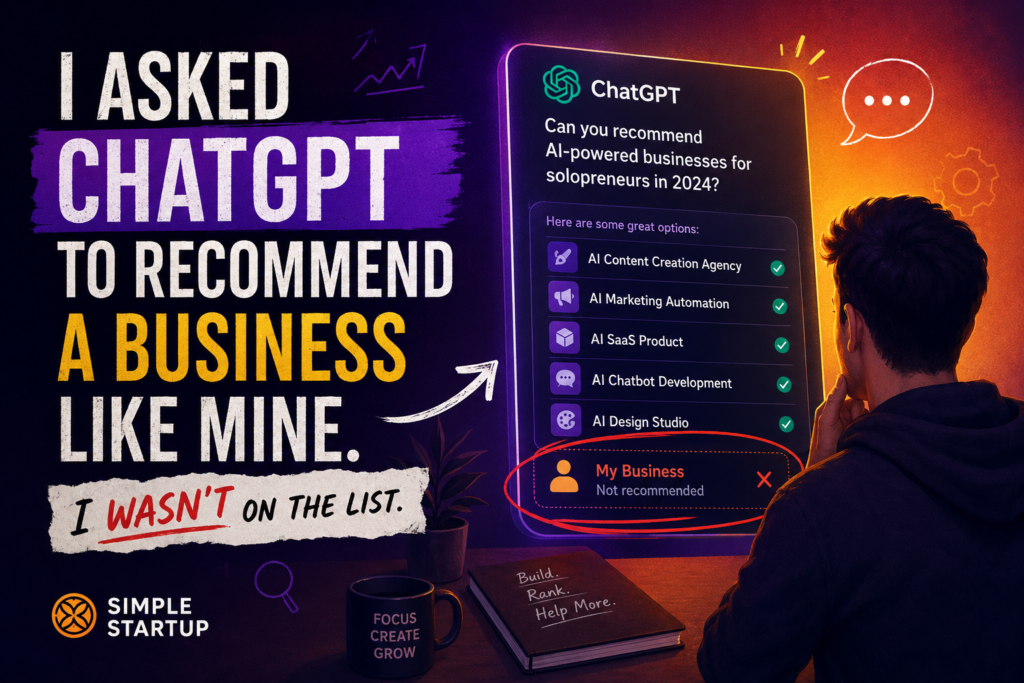
I ran the test on my own business. I wasn’t on the list. Here’s what that revealed about AI visibility.
Last week I ended my SEO post with a two-minute homework assignment: open ChatGPT, ask it about your niche, and see if you exist.
This week I ran it on my own business.
I figured I’d do okay. I’ve been doing SEO for over a decade. As I write this, Simple Startup ranks near the top of Google organic search for “how to run a one-person business with AI” and “SEO for solopreneurs”… the exact territory I was about to test.
So I asked ChatGPT and Perplexity the questions my ideal reader would actually ask. Five of them. The exact questions this site was built to answer.
I wasn’t on the list. Not once.
And then I asked one more question… and the answer to that one changed the entire way I think about this problem. Stay with me, because the twist matters more than the failure. This post is the full experiment: what I asked, who got picked instead of me, why, and what it actually takes to get recommended by ChatGPT when a buyer asks.
How to Get Your Business Recommended by ChatGPT: The 5-Step Plan
The short answer: getting recommended by ChatGPT takes more than ranking on Google. Your business needs clear entity information, direct answers to buyer questions, authoritative third-party mentions, tightly connected content, and original evidence AI systems can cite. In practice, that’s five moves:
- Answer buyer questions directly… FAQ blocks and headers that mirror how people actually ask.
- Clarify your business entity… one consistent bio everywhere, a plain About page, schema markup.
- Build tightly connected topic clusters… internal links that teach machines what your site is about.
- Earn third-party mentions and recommendations… roundups, directories, podcasts, communities. This one matters most.
- Publish original experiments and evidence… receipts AI can quote and attribute.
That’s the plan, and I break down each step later in this post. But first, let me show you what happened when I ran the test on my own site… because the results explain why these five fixes are the ones that matter.
The Experiment
Here’s what I asked, phrased the way a real person would ask it:
- What are the best resources for solopreneurs who want to use AI agents to run their business?
- Recommend blogs or newsletters about starting a one-person online business with AI.
- I’m a coach who wants to launch a digital product. What websites or tools should I use to get started?
- How do I run a one-person business with AI? Where should I learn this?
- What’s a simple business plan template for a solopreneur?
No tricks. No obscure phrasing. These are my keywords, my audience, my lane. Question 4 is almost word-for-word the title of a 2,257-word post I published two days earlier.
1. The Humbling Part: AI Recommended Everyone But Me
Ask Perplexity for blogs and newsletters about running a one-person business with AI, and you get a confident, well-organized answer: The Rundown AI. Ben’s Bites. TLDR AI. Lenny’s Newsletter. Techpresso. A couple of Entrepreneur articles.
All fine picks. None of them are a solopreneur teaching this from inside a one-person business. Lenny’s Newsletter is brilliant… it’s also written for product managers at tech companies. The Rundown is AI news, not business building. The reader who asked that question wanted someone like me. The AI gave them everyone but.
The coach question was worse, in an instructive way. Perplexity built a whole starter stack: Paperbell, Gumroad, Payhip, Stan Store, Podia, Canva, Teachable. Notice what those have in common. They’re all tools. A coach asked “where do I start” and got a shopping list.
But the one that stung was question 4. Two days before I ran this test, I published a post targeting that exact phrase: how to run a one-person business with AI. Perplexity’s answer? Five YouTube videos, including one called “How to Start a 1-Person Business with AI ($0 to $1M).”
A dollar-sign thumbnail beat a decade of experience.
Then I gave ChatGPT the fairest shot I could. Temporary chat, so nothing about me could leak in. Web search on, so it wasn’t limited to old training data. I asked: “What are the best resources on how to run a one-person business with AI?”
It searched the web three times. It came back with a thoughtful, well-reasoned, eight-item resource stack: OpenAI Academy. Anthropic’s AI Fluency course. Ethan Mollick. The Mom Test. Company of One. Zapier Academy. Y Combinator’s Startup Library. Indie Hackers. It even surfaced a SCORE webinar happening two weeks from now.
Remember: I rank near the top of Google for that exact phrase. ChatGPT was live-searching the same web I rank on… and still didn’t say my name. I ran it once more for “best resources for SEO for solopreneurs,” another phrase I rank for. Google Search Central, Ahrefs, Semrush, LearningSEO.io.
That’s the market I’m competing in. That’s the market you’re competing in too.
2. The Twist: AI Knows Exactly Who I Am
Here’s where it gets strange.
After the buyer questions failed, I asked ChatGPT directly: “What is simplestartup.net? Who is Mayank Gupta of Simple Startup?”
It knew everything.
It described the site accurately… an educational platform helping solopreneurs build one-person businesses with AI agents, digital products, and automation. It knew I’m a Canadian digital marketer. It knew I’ve been publishing since 2015. It found my LinkedIn and my university. It summarized the “AI headquarters” concept from the post I’d published two weeks earlier, correctly, in its own words. It even helpfully warned readers not to confuse my site with simplestartup.com, an accounting firm.
Sit with that for a second.
AI has read my work. It can summarize my frameworks. It quotes my own articles back to me. It knows the difference between me and a similarly-named accounting company.
It just never says my name when a buyer asks.
And it gets one level stranger. When I asked ChatGPT the “where should I learn this” question from my own logged-in account (so, to be fair, it knew who was asking), it built me a beautiful plan… a central business knowledge base it called an AI headquarters, using my own term from my own article. Then it listed where to learn all this: Ethan Mollick’s newsletter, OpenAI Academy, Company of One, The Mom Test, Greg Isenberg’s channel.
A genuinely good reading list. But think about what just happened. The AI was teaching my framework, sourced from my site, while recommending everyone except the site it learned it from. Even when the machine is literally looking at your content, its recommendation reflex reaches for the famous names.
3. The Gap Nobody Talks About: Findable Is Not Recommendable
This is the finding, and it’s bigger than my little experiment.
For twenty years, the game was findability. Someone types words into Google, Google matches those words to pages, your page shows up. Rank well and the road leads to you. That game still exists… I still win at it. My posts rank.
But AI recommendations are a different game entirely. When someone asks “what should I read?” or “who should I learn from?”, the AI isn’t matching words to pages. It’s recalling entities… names it has seen recommended, listed, linked, and cited, over and over, in connection with that question.
Think of it like a job market. Being findable means your resume is in the database… if someone searches for you, they’ll get the full file. Being recommendable means your name comes up in the meeting when someone asks “who should we hire?”… and nobody searched for anything.
AI read my resume. It just never brings me up in the meeting.
And here’s the uncomfortable part: everything I’ve done for a decade… keyword research, on-page SEO, quality content… optimizes for the database. Almost none of it optimizes for the meeting.
4. Why ChatGPT Doesn’t Recommend Your Business (It’s Not Quality)
Look again at who got recommended: The Rundown AI. Ben’s Bites. Podia. Gumroad. Teachable. YouTube videos with big view counts.
What do they have in common? Co-mentions. The Rundown and Ben’s Bites appear on hundreds of “best AI newsletters” listicles. Podia and Teachable live on every “tools for coaches” roundup ever written. Those YouTube videos get embedded, shared, and linked next to the exact question I tested.
AI recommends the names it has seen recommended. It’s pattern-matching on reputation, and reputation… in the AI’s eyes… is frequency of association. When thousands of pages say “for coaches, use Podia,” the model learns coaches → Podia. Nobody has written “for solopreneurs building with AI, read Simple Startup” a thousand times.
Yet.
And no, web search doesn’t rescue you. That was the part of my experiment that surprised me most. When ChatGPT browsed the live web… the web where I rank… it still came back with academies and aggregators. Because when you ask for “best resources,” the AI searches for pages that answer that question, and those pages are roundups, directories, and official course libraries. It recommends what the roundups recommend. If you’re not on those pages, ranking near them doesn’t count.
That reframing matters, because it tells you the fix isn’t “write better content.” My content was good enough for the AI to read, learn from, and summarize. The fix is making sure your name gets associated with the questions your buyers ask… in more places than your own website. The silver lining: small sites are better positioned for this game than the big brands are… I make the full case in my guide to AI search optimization for small business.
5. The Five Fixes in Detail (What I’m Actually Doing)
This is my repair plan, in the order I’m doing it. It doubles as yours. None of it requires a big brand… it requires doing the right unglamorous things in the right order.
First: answer buyer questions, not just keywords. AI engines quote question-shaped content… FAQ blocks, headers that mirror how people actually ask. I’ve started adding an FAQ to every post (there’s one at the bottom of this page). If your pages don’t contain the literal questions your buyers ask, you’re invisible to the surface AI quotes from. My AI search guide goes deep on this.
Second: make your entity unmistakable. AI almost confused me with an accounting firm. Same name, different domain. So: one consistent bio everywhere (site, LinkedIn, guest posts), a proper About page that states plainly what Simple Startup is and who it’s for, and schema markup so machines don’t have to guess. Boring work. An afternoon. Do it once.
Third: wire your site into a cluster. My older posts barely link to each other, which means a crawler can’t tell what the site is about. Every post I touch now gets wired into its topic cluster. A site with 24 tightly linked pages about one subject beats a site with 46 scattered ones… for Google and for AI.
Fourth: go where the co-mentions happen. This is the big one, and the least comfortable. Recommendations live off-site: newsletter directories, “best of” roundups, podcast guest spots, communities, other people’s listicles. For a solopreneur, that looks like pitching two guest spots a month, getting your newsletter listed in the directories AI keeps citing, answering real questions in the communities AI browses, and being quotable enough that roundup writers include you. I’ve spent years producing and hours distributing. That ratio is now backwards. When AI makes production nearly free, production stops being the differentiator… distribution is the work.
Fifth: publish receipts. AI loves citing specifics: experiments, numbers, screenshots, original data. This post is that strategy. Generic advice is infinite and free now. A documented experiment on a real business is something an AI can actually quote… and attribute.
None of this is a hack. Notice that. There’s no secret tag, no prompt trick. It’s reputation-building, sped up by knowing exactly what the machine measures.
Run This Test on Your Business Today
You don’t need my results. You need yours. Ten minutes:
- Open a temporary chat in ChatGPT (so your own history doesn’t flatter you) and ask the question your ideal customer would ask… “best resources for [your niche]”, “recommend blogs about [your topic]”.
- Ask it directly: “What is [yourbusiness.com]? Who is [you]?”
- If you have Perplexity, repeat question 1 there and look at who gets cited instead of you.
Three outcomes are possible. AI doesn’t know you exist: you have an entity problem… start with fixes one and two. AI knows you but never recommends you (my result, and the most common one): you have a co-mention problem… fix four is your priority. AI actually recommends you: write me, because I want to interview you.
Whatever you find, write it down with today’s date. That’s your baseline. In 90 days, run the same three prompts again.
Free interactive workbook
Get the 90-Day AI Visibility Action Plan
The five fixes in this post, turned into a fill-in workbook: the checklists, the 6-prompt library, the worksheets, and a 12-week tracker. Type in it, click the checkboxes, save your progress.
Plus one practical idea a week for your one-person business. No spam. Unsubscribe anytime.
The 90-Day
AI Visibility
Action Plan
Checklists, worksheets, and copy-paste prompts. Get found by Google and ChatGPT.
Before you go… it’s free
Turn this post into your 90-day plan
The interactive workbook version: checklists, the 6-prompt library, worksheets, and a 12-week tracker. Fill it in right on your screen.
One practical idea a week. No spam. Unsubscribe anytime.
The 90-Day
AI Visibility
Action Plan
Checklists, worksheets, and copy-paste prompts. Get found by Google and ChatGPT.
The Part I Keep Coming Back To
Here’s the reframe I can’t shake.
I spent ten years learning to win the findability game, and I did… my posts rank. Then the game changed rooms. Buyers stopped searching and started asking. And in the asking game, the winners aren’t the best sites. They’re the most-mentioned names.
That should discourage me. It doesn’t. Because frequency of association is something a one-person business can build deliberately… one guest post, one directory listing, one documented experiment at a time. The big brands got their co-mentions by accident of scale. You and I get to earn ours on purpose.
AI didn’t put me on the list. Fine. The list is public, the scoring system is knowable, and I have receipts the incumbents don’t.
Run the three prompts today. Save your baseline. Start small.
Want the whole system? The Free Startup Toolkit has the templates and AI workflows I’d start with. And if you want one practical idea like this every week, join the newsletter… I publish what I learn as I fix this in public, and the next post in this series will show whether the needle moved.
FAQ
What is AI visibility for solopreneurs?
AI visibility is how often AI assistants like ChatGPT, Perplexity, and Claude mention or recommend your business when people ask questions in your niche. It’s different from SEO: ranking on Google makes you findable, but AI recommendations depend on how often your name appears in association with your topic across the wider web.
How do you get your business recommended by ChatGPT?
Build frequency of association between your name and the questions your buyers ask. In practice: publish question-shaped content with FAQ blocks, make your business entity unmistakable with a consistent bio and schema markup, link your site into tight topic clusters, earn co-mentions on roundups, directories, and podcasts, and publish original receipts AI can cite. Off-site mentions matter more than most people expect.
Why doesn’t ChatGPT recommend my business?
Because AI models recommend entities they’ve repeatedly seen connected to a question… in listicles, directories, reviews, and citations. Big newsletters and tools win because they’re mentioned on hundreds of roundup pages. Quality matters less than frequency of association, which is why excellent small sites often go unrecommended.
Does ranking on Google help you get recommended by AI?
It helps, but it’s not enough. My site ranks near the top of Google for “how to run a one-person business with AI,” yet when ChatGPT web-searched that exact question in a clean chat, it recommended eight resources… none of them mine. Rankings make your content available for AI to read. Co-mentions on roundups, directories, and other people’s sites are what make AI actually suggest you.
How do I check my own AI visibility?
Ask ChatGPT (in a temporary chat, so your history doesn’t skew results) the questions your ideal customer would ask, then ask it directly what your website is. Repeat in Perplexity and note who gets cited. Record the results with the date so you can measure change over 90 days.
How long does it take to show up in AI recommendations?
There’s no fixed timeline, and anyone promising one is guessing. Structural fixes like FAQs, schema, and internal linking can surface in AI search tools within weeks since they browse the live web. Being recommended from a model’s memory takes longer… months of accumulating mentions… which is exactly why starting your baseline now matters.