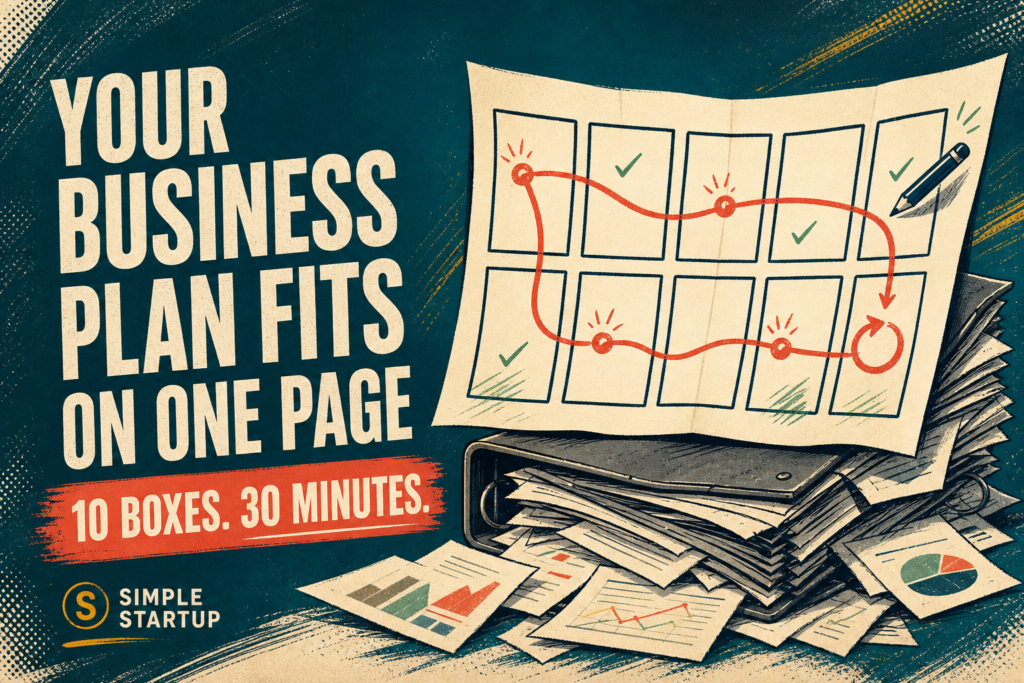
You don’t need 40 pages. You need one page, filled in honestly. Here’s the exact canvas I use for my own business… all 10 boxes, with my real answers.
Somewhere on your hard drive, there’s probably a business plan.
You know the kind. The 40-page document with five-year financial projections. The market-size analysis copied from a report you skimmed. The org chart… for a company of one.
Be honest: when did you last open it?
Here’s the uncomfortable truth about traditional business plans: they’re prediction documents, and solopreneurs don’t need predictions. We need tests.
A 40-page plan says “here’s what will happen.” It’s fiction with a spreadsheet. What you actually need fits on one page and says something much more useful: “here’s what I believe, and here’s how I’ll find out if I’m wrong.”
Steve Blank, the godfather of the lean startup movement, defined a startup as “a temporary organization formed to search for a repeatable and scalable business model.”
Read that again. A search. Not an execution of a plan… a search.
Your business plan should be a map for that search. One page. Ten boxes. Rewritten as reality teaches you things.
That’s what the Simple Startup Canvas is, and in this post I’ll walk you through every box… using my own business as the worked example, so you can see what honest answers actually look like.
The Business Plan for Solopreneurs: The Short Version
A solopreneur business plan needs to answer ten questions, each in a sentence or two:
- Problem… what pain do you solve?
- Solution… how, specifically?
- Unique Selling Proposition… why you and not the obvious alternative?
- Unique Advantage… what can’t be copied easily?
- Customer Avatar… who exactly is this for?
- Existing Alternatives… what do they do today instead?
- Traffic Sources… how will they find you?
- Key Metrics… what numbers tell you it’s working?
- Pricing… what will they pay, and how?
- Business Model… how does this become a living?
If you can fill all ten honestly, you have a business plan. If a box stays empty… that’s not a writing problem. That’s your business telling you what to figure out next.
Let’s go box by box.
Why One Page Beats Forty (Especially Now)
One more thing before the boxes, because the timing matters.
In 2016, a long business plan was at least work. It proved effort. In 2026, ChatGPT will generate you a 40-page business plan in ninety seconds… market analysis, projections, executive summary, the works.
Which means the long plan is now worth exactly what it costs to produce: nothing.
When plans are free to generate, the honest one-pager becomes the only version worth writing. AI can fill boxes with plausible words. It can’t know that your real customers, the ones you actually talked to, care about time more than money. Only the work of finding out fills the canvas truthfully.
Here’s the difference in one picture. The 40-page plan says: “The global coaching market is projected to reach $27 billion by 2028.” Impressive. Useless. The canvas says: “My customer is a burned-out project manager who wants to coach on the side, and today she’s watching free YouTube videos instead of buying anything.”
One of those sentences tells you what to do on Monday.
The canvas isn’t shorter because you’re small. It’s shorter because it only contains the parts you have to earn.
The 10 Boxes (With My Real Answers)
For each box: what it asks, how to answer it, and what I actually wrote for Simple Startup… so you can see the difference between a filled box and an honest one.

1. Problem
What painful, expensive, or frustrating thing does your customer live with?
Not a category (“marketing is hard”). A moment. The Tuesday-night version of the pain.
My answer: solopreneurs want a real online business, but the busywork of running one… content, emails, tech, promotion… eats the hours they’d need to build it. They’re one person doing five jobs badly instead of one job well.
2. Solution
How do you make that pain go away, specifically?
My answer: practical systems where AI agents do the busywork… drafting, publishing, research, follow-up… while the founder makes the decisions. Taught through free tools, a weekly newsletter, and my own business run this way in public.
One sentence. If your solution needs a paragraph, you don’t have a solution yet… you have several.
3. Unique Selling Proposition
Why should someone pick you over the obvious alternative?
My answer: I’m not a guru with a team of twelve selling the solo dream. I’m actually one person, and every system I teach runs my own business first. The receipts are public.
Notice what a USP is made of: something true about you that the alternative can’t say.
4. Unique Advantage
What do you have that can’t be easily copied?
This is the box most people fake. “Passion” is not an advantage. “Quality” is not an advantage.
My answer: a decade of SEO and digital marketing experience, plus a working AI-headquarters setup (my exact system is documented here) that took months to build and tune. Someone starting today is a year behind.
If this box is empty for you, that’s fine… it fills over time. Your advantage next year might be the audience or the case studies you build this year.
5. Customer Avatar
Who exactly is this for? One person, not a demographic.
My answer: the solopreneur or coach a few years into working life, tired of hype, who wants a real online business alongside or instead of a job… and who’s curious about AI but doesn’t want to become a programmer.
Test yourself: could you recognize this person in a coffee shop conversation? If your avatar is “adults 25-54 interested in business”… you can’t.
6. Existing Alternatives
What does your customer do about the problem today, without you?
Wrong answer: “there are no competitors.” There are always competitors, and the deadliest one is usually a spreadsheet, a $997 course, or doing nothing.
My answer: expensive guru courses, drowning in free YouTube content, or duct-taping tools together alone. Each one either costs too much, overwhelms, or collapses the first busy week.
Your marketing writes itself from this box: you are the thing that fixes what the alternatives get wrong.
7. Traffic Sources
How will your ideal customer actually find you? Pick two or three… not eight.
My answer: SEO and AI search (being the cited answer for solopreneur questions… here’s why small sites have the edge there), plus the email list as the owned channel everything feeds.
The discipline is in what you don’t list. Every channel you add halves the attention the others get.
8. Key Metrics
Which two or three numbers tell you the search is working?
Not vanity numbers. A thousand followers who never buy is decoration.
My answer: email subscribers (the asset), opt-in conversion rate (is the content reaching the right people?), and revenue per offer once products launch. That’s it… three numbers I can check in five minutes a week.
9. Pricing
What will they pay, and what’s free?
My answer: free tier (blog, newsletter, Toolkit, this Canvas) builds trust; paid digital products priced for impulse-purchase territory rather than premium-course territory, because my avatar has been burned by $997 promises before.
Notice the pricing follows from box 5 and box 6. That’s the point of a canvas… the boxes argue with each other until they agree.
10. Business Model
How does this all become a living?
My answer: audience-first: free content → email list → digital products and tools, with the AI-agent systems keeping costs near zero so profitability doesn’t require scale.
One person, low costs, owned audience, digital products. It’s not novel. It doesn’t need to be. A boring model executed weekly beats a brilliant model executed never.
Now Pressure-Test It (This Is Where AI Actually Helps)
Remember how I said AI shouldn’t write your plan? Here’s what it should do: attack it.
Once your ten boxes are filled, paste them into ChatGPT or Claude with this prompt:
Here's my one-page business plan. Play a skeptical investor.

Find the three weakest boxes.
For each one, tell me:
  - what evidence would prove it wrong
  - what the cheapest test of that assumption would be

[paste your ten boxes here]
Ten minutes of that is worth more than a week of polishing. The canvas states your beliefs… the AI helps you find which belief to test first, and the test is always cheaper than you think. Two emails. One landing page. Five conversations.
And if you run my canvas through that prompt, the attack will probably land on box 7. “SEO and AI search” compounds slowly… so what brings the first hundred subscribers before it kicks in? Fair hit. That’s the box I’m testing right now, in public, by publishing daily and measuring what converts.
A canvas with a known weak spot isn’t a failed plan. It’s a plan that knows what it’s doing next.
Your First Canvas: 30 Minutes, Tonight
Here’s the whole assignment:
- Set a timer for 30 minutes and fill all ten boxes with your current best guesses. Ugly is fine. Guesses are fine… that’s what a search starts with.
- Mark your shakiest box… the one you’d least want a skeptic to poke.
- Design one cheap test for it this week. Ask five potential customers about the problem. Put up one page describing the solution. Send two pitches.
Then rewrite the box with what you learned, and repeat. That loop… guess, test, rewrite… is the entire method. The canvas just keeps the loop honest.

Free fillable workbook
Get the Simple Startup Canvas
Everything in this post as a fill-in PDF: the one-page canvas, a guided worksheet for all ten boxes, the AI pressure-test prompt, and a rewrite log. Type straight into it. Thirty honest minutes.
Plus one practical idea a week for your one-person business. No spam. Unsubscribe anytime.
Before you go… it’s free
Don’t just read about the canvas. Fill one in.
Grab the fill-in PDF: the one-page canvas, a guided worksheet for all ten boxes, and the AI pressure-test prompt. You could have version 1 done in 30 minutes.
One practical idea a week. No spam. Unsubscribe anytime.
The Bigger Picture
Here’s the reframe I want to leave you with.
A business plan was never supposed to be a document. It was supposed to be a set of decisions… who you serve, what you promise, how they find you, what they pay. The 40 pages were packaging.
The packaging impressed banks. It never impressed customers.
So write the one page. Test the shakiest box. Rewrite it when reality talks back. In a year, your canvas will have been rewritten five times, and every rewrite will mean you learned something true about your business.
That’s not a smaller business plan. That’s the first one that actually works for a business of one.
Start with box 1. Tonight. Thirty minutes.
FAQ
Do solopreneurs actually need a business plan?
Yes… but not the traditional kind. Nobody’s asking a one-person business for a 40-page document; there’s no bank or board to impress. What a solopreneur needs is a one-page plan that forces clear decisions: the problem, the customer, the offer, the traffic sources, the pricing, and the numbers that prove it’s working. That fits on a single canvas and takes about 30 minutes to draft.
What should a business plan for solopreneurs include?
Ten things: the problem you solve, your solution, your unique selling proposition, your unfair advantage, your ideal customer, the existing alternatives, your traffic sources, your key metrics, your pricing, and your business model. Each needs only a sentence or two… the value is in answering honestly, not writing at length.
How is a business model canvas different from a business plan?
A traditional business plan predicts: it describes what you expect to happen over years, in detail. A canvas tests: it states your current assumptions on one page so you can check them against reality and rewrite them cheaply. For a one-person business searching for what works, the canvas fits the actual job.
Can I just have AI write my business plan?
AI can generate a plausible-sounding plan in seconds… which is exactly why that plan is worthless. The value of a business plan is that its answers are earned from real customers and real tests, not predicted. Where AI genuinely helps: pressure-testing a plan you wrote. Ask it to attack your assumptions and design cheap tests for the weakest ones.
How often should I update my business plan?
Every time reality teaches you something… which early on might be monthly. Each cheap test you run (customer conversations, a landing page, a small launch) should either confirm a box or rewrite it. A canvas that hasn’t changed in a year usually means the testing stopped, not that the plan was right.