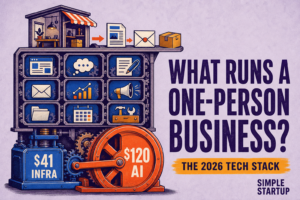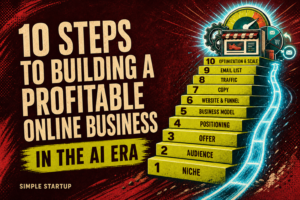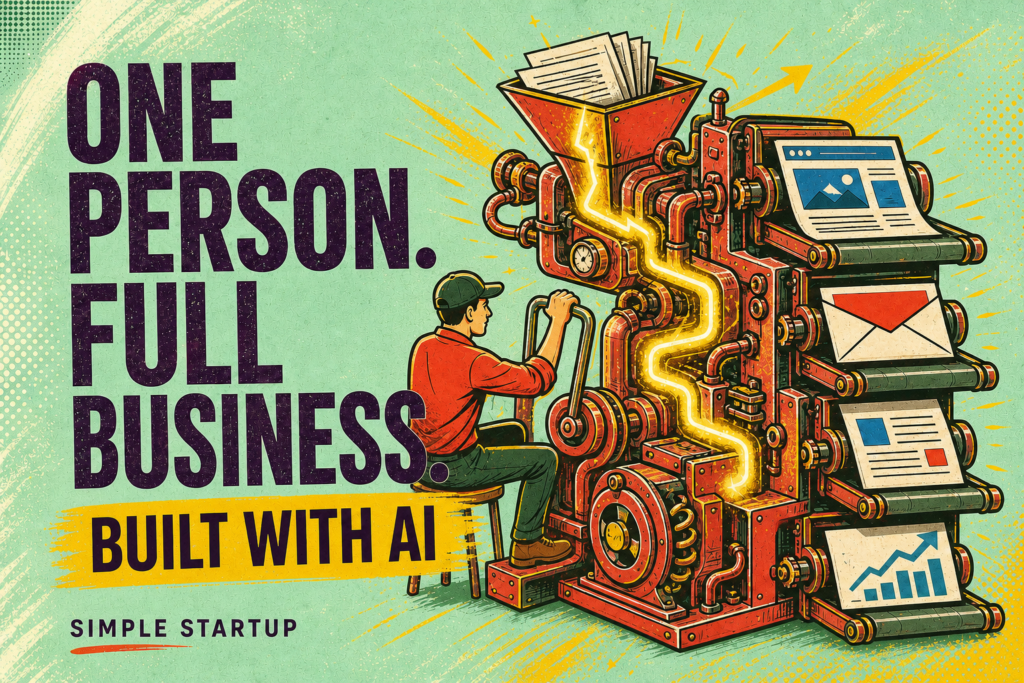
Everyone’s starting one. Almost nobody’s building one. Here’s the difference… and the exact path across it.
I’ve been doing business solo since 2008.
Eighteen years working for myself. And for most of them, “solopreneur” wasn’t a compliment… it was a polite word for “can’t afford to hire yet.”
All the advice pointed the same direction: build a team, delegate, scale. One person was a hobby. A team was a business.
I never fully bought it. But I couldn’t prove it wrong either.
Then this month, Bloomberg published a piece I read three times. New business applications in the US are surging. Census data shows formations in professional and technical services up about 45% since ChatGPT launched.
And here’s the detail that made me sit up. Nasdaq’s economists dug into who is behind the surge: one-person business applications are up more than 20% since early 2025, and nearly all the acceleration is coming from solo founders and independent contractors.
Not startups with headcount. People with a laptop… and quietly, AI doing the work of the team they never hired.
Nasdaq’s economist put it plainly: a solo consultant with a $200-a-month AI subscription can now match, or even beat, the output of a small team.
Eighteen years later, it’s not a hobby anymore. Almost all of the growth in new American businesses is now one person.
But before you go register a domain, I need to tell you the part the headlines skip.
Starting was never the hard part. It just used to be expensive enough that we could pretend it was.
The hard part is what comes after you decide. And that part didn’t disappear. It moved. This new wave of solopreneurs is going to split into two groups: people who started something, and people who built something.
The difference won’t be talent or money. It’ll be whether they had a path or just a vibe.
Here’s the path.
How to Start a One-Person Business with AI in 2026: The Short Answer
You work through four stages:
- Plan… pick one person to help, put the whole plan on one page, shape one offer.
- Build… create a lead magnet, one landing page, one welcome email sequence.
- Launch… publish useful content in your lane and repurpose it to social.
- Grow… automate the busywork, but only after it works manually.
AI does the production at every stage: the drafts, the pages, the research, the repetitive checks. You do the judgment: who you serve, what you promise, what you charge.
That’s the model. Nine steps live inside it, and I’ll walk you through all nine, with the actual tools I use at each one, because “use AI” is advice the same way “eat food” is a diet.
First, though, I want to convince you the ground actually shifted. If you don’t believe that part, the steps are just another listicle.
1. Why One Person Is Finally Enough
Think about what a small business needed a team for. Not long ago. Five years, maybe.
Someone to design the website. Someone to write the emails, and a different someone who understood the email software, because those were never the same person. Social media. Analytics. Somebody to read the numbers and tell you what they meant, usually wrongly.
None of those people were the business.
They were overhead. Scaffolding around the one thing that actually made money: your skill, your judgment, your taste.
AI didn’t replace the business. It replaced the scaffolding.
Here’s what that looks like on my desk, today:
- The website… WordPress with the Bricks builder. A Claude agent edits pages directly, and I review every change before it counts.
- The email machine… FluentCRM, running right inside my WordPress install. Signup forms are Contact Form 7. No Mailchimp bill, no Zapier duct tape.
- The writing room… Claude drafts alongside me. Its Fable 5 model orchestrates the big multi-step jobs (audits, research, wiring) and Opus is my daily driver for drafts and thinking. ChatGPT gets a seat too: I use it to sanity-check how my business looks from the outside, which turned into a whole experiment I’ll tell you about in a minute.
- Distribution… Buffer queues my X and Facebook posts. Nothing goes out without my approval, but nothing waits on my energy either.
- SEO… Yoast for the on-page basics, and me checking the actual search results before I pick a keyphrase. That last part matters more than any plugin.
Add it up and I run this entire site (content, email, SEO, social, the works) in three to four focused hours a day. I’ve written up the full setup in how I run a one-person business with AI.
Five years ago, that list was five salaries.
2. What AI Changed… and the Three Things It Didn’t
This is where most posts about AI businesses start lying to you, so let me be careful here.
What actually changed:
- Production is free now. A landing page draft before lunch. A week of social posts in one sitting. This used to be the bottleneck. It’s gone.
- Technical skill stopped being a gate. You describe what you want in plain English. I’ve built Bricks pages, FluentCRM automations, even actual software this way. No code. I still can’t quite believe it some days.
- One person can hold the whole machine in their head. Because AI holds the details you’d otherwise drop.
What didn’t change? Read these slowly, because every failed AI business I’ve watched ignored at least one:
It can’t pick your customer. That’s a decision. Decisions are still yours, and they’re still uncomfortable.
It can’t make anyone care. When everyone can produce everything, attention flows to people with real judgment and real receipts. I learned this one the embarrassing way… I asked ChatGPT to recommend a business like mine and it never mentioned me. It knew my site existed. It quoted a phrase I invented straight back at me. Still didn’t recommend me.
It can’t want it for you. Consistency is still the price of all of this. AI just marked it down from 40 hours a week to a few.
Keep both lists. You’ll need them.
3. The Path: Nine Steps, Four Stages
This is the sequence I use, in order, and the order matters more than people think.
Each step produces one concrete thing you can point at. Can’t point at it? The step isn’t done. Doesn’t matter how busy you were.
Stage 1: Plan
Step 1: Direction. One sentence: I help [a specific person] get [a specific result].
Say it out loud. Actually out loud. If it takes a paragraph, you don’t have direction yet… you have fog. This step costs nothing, which is exactly why everyone skips it and stalls in week three wondering why nothing they make lands.
Step 2: Canvas. Your whole plan on one page. Not thirty pages. Nobody reads thirty pages, including the person who wrote them. I know because this site still has posts I wrote in 2016 that I haven’t reread.
One page, a handful of uncomfortable questions: who, what problem, what offer, what proof, which channel. Twenty minutes, typed straight into a fillable PDF. I wrote up the full business plan for solopreneurs approach if you want to go deeper.
Step 3: Offer. One thing. One price. For the person in Step 1.
But don’t build it yet. Sell it first.
Have five real conversations with that person… not a survey, a conversation. Then offer the thing by hand: a DM, an email, a call. No page, no logo, no automation.
The first manual sale (or the first honest “no”) teaches you more than the next six steps combined. Deliver it yourself, watch where it wobbles, and fold what you learn back into the offer.
And resist building three offers. The second one is a reward for selling the first. That’s not a rule I read somewhere. It’s a rule I broke first.
Stage 2: Build
Everything in this stage assumes Step 3 ended with money changing hands at least once. You’re not building to find out if people want it. You already know.
Step 4: Lead magnet. One free thing that solves one specific problem in under twenty minutes. A checklist. A scorecard. A one-page canvas.
Mine took four design rounds before I’d ship it. Round one looked like every template on Etsy, and I threw it out. (Nobody finishes your 100-page ebook, by the way. I promise.)
Step 5: Page. One landing page, one job: explain the offer, collect the email. I build mine in Bricks, and Claude drafts the copy against my own checklist before I touch it.
Don’t build a website. Build a page. Websites are where new solopreneurs go to hide from the scary part for six weeks.
Step 6: Emails. Two pieces here: an instant delivery email, then a short welcome sequence. The delivery chain first, because seeing it written out makes it stop feeling complicated:
A Contact Form 7 form on the post → submitting it applies a tag in FluentCRM → the tag fires an automation → the automation sends one delivery email with one button.
That’s it. Four links in a chain, written once, working while I sleep.
The welcome sequence picks up from there… a handful of short emails over the next week that tell your story, share your best work, and make your offer once. Not a newsletter. A welcome.
Then test it with your own real email. I found a broken redirect on mine exactly that way. It would have quietly failed for every single subscriber, forever, and I’d never have known.
Stage 3: Launch
Step 7: Content. One useful post a week, in your lane, answering questions your person actually types.
This is the long game. It’s how Google learns you exist. And now it’s how ChatGPT and Perplexity learn you exist too, which is a fight small sites can genuinely win. I’ve shown how small sites beat big brands in AI search with receipts.
Step 8: Social. Repurpose, don’t create. Every post becomes a thread, two short posts, maybe a carousel.
Claude drafts them from the finished post, they land in my Buffer queue, I approve or fix each one. Thirty minutes. Without this setup it’s a second career, which is why you stopped doing it last time.
Stage 4: Grow
Step 9: Automate. Deliberately last. Automate only what already works manually. Automating a broken process just breaks things faster and with more confidence.
When something works by hand three times, hand it to an AI agent and check its work like you’d check a new employee’s.
Nine steps. Each one small. Your version might lean harder on some than others… a consultant doing outbound can live without a lead magnet for a while… but the spine doesn’t change: decide, sell it once by hand, build the machine, then automate.
4. I’m Not Recommending This Path. I’m On It.
Everything above is how Simple Startup actually runs.
Last month I had Claude audit all 46 posts on this site: every URL, every opt-in, every internal link. The verdict stung. Exactly one post out of 46 had a working email opt-in.
One.
My best-ranking post was collecting emails through an old form still wired to ActiveCampaign… an account I’d stopped paying for. Years of traffic, quietly evaporating into a dead inbox.
That’s the kind of thing you find when you finally follow your own path instead of just publishing and hoping. Claude found it in an afternoon. Fixing everything it found… that’s been my July.
And I’ll go one further. I believe in these nine steps enough that I’m building my next product around them: an app where a solopreneur walks this exact journey step by step, with AI helping at every station but never taking the wheel.
Claude writes most of the code. Supabase holds the data. I make every product decision. I’m not ready to share the name yet (partly because I keep changing my mind about it).
It’s the most fun I’ve had building anything in years. More soon.
5. What This Doesn’t Mean
Three caveats, so we stay honest with each other:
- Not overnight. The Census counts formations, not survivors. This path takes weeks of small consistent effort. Not a weekend, whatever the YouTube thumbnails say.
- Not passive. “AI runs my business while I sleep” is a screenshot fantasy. AI runs my busywork while I sleep. The business still needs me. It just needs a lot less of me.
- Not everything. A restaurant needs staff. A factory needs a factory. But if your value is knowledge, skill, or creativity (coaching, digital products, services, content), one person is now enough. That covers more businesses than you’d think. Probably yours.
Free fillable workbook
Get the Simple Startup Canvas
Step 2 of the path, done for you: a fill-in PDF with the one-page canvas, guided questions for every box, and the AI pressure-test prompt. Type straight into it. Twenty honest minutes.
Plus one practical idea a week for your one-person business. No spam. Unsubscribe anytime.
Before you go… it’s free
Don’t just read the path. Start it.
Grab the fillable Simple Startup Canvas… your whole plan on one page, plus the AI pressure-test prompt. You could have version 1 done tonight.
One practical idea a week. No spam. Unsubscribe anytime.
The Part Worth Remembering
For basically all of history, “starting a business” meant assembling other people first. Team, then work. And most dreams died right there at the hiring step… not because the idea was bad, but because one person couldn’t carry five people’s overhead to find out.
I spent eighteen years watching that constraint from the inside. Then it dissolved… quietly, in about three years, while everyone argued about whether AI was overhyped.
The wave of solo founders filing new business applications every month? They’ve stopped arguing.
The only question left is the one AI can’t answer for you: what will yours be?
One page. Twenty minutes. Today.
Start with Step 1: grab the free Simple Startup Canvas above and write your direction sentence… I help [who] get [what]… in the first box. That’s the whole assignment.
And if you want the bigger kit, the Free Startup Toolkit has the templates, tools and AI workflows I use to run this whole business solo.
FAQ
Can you really start a one-person business with AI?
Yes… and the data backs it. Nasdaq reports one-person business applications up more than 20% since early 2025, with nearly all the acceleration in US business formation coming from solo founders and independent contractors. AI handles production (pages, emails, drafts, research); you handle decisions (who you serve, what you offer, what you charge… and who you sell to first).
What’s the best one-person business to start with AI?
The one where you already have judgment: skills, experience, or results people ask you about. Coaching, consulting, digital products, templates, productized services. AI can produce the materials but it can’t produce your expertise, so start where yours already is.
How much does it cost to start a one-person business with AI?
Less than most people burn on a logo. My stack: WordPress hosting, the Bricks builder, FluentCRM, Buffer, and a Claude subscription. Realistically under $100 a month all-in. The real investment is consistent time, not money.
How many hours a day do you need?
Three to four focused hours is enough to build seriously. That’s my own schedule running this site and building a product on the side. The nine steps are designed for exactly that: small concrete moves that compound.
Do you need technical skills?
You don’t need to be a developer. Plain English became a programming language… if you can write a clear sentence about what you need (a Bricks page, a FluentCRM automation, a simple tool), you can build it. What you still need: the patience to describe things clearly, test what AI gives you, and catch its mistakes before your readers do.