The steps to a profitable online business haven’t changed much in a decade. Who can actually do them has changed completely.
I’ve been building online businesses since 2008.
In that time, the advice has reinvented itself at least four times. Blog your way to freedom. Funnel hack your way to millions. Build a personal brand. Now: let AI do everything.
Here’s what I’ve noticed, eighteen years in: the tools keep changing costumes… the steps barely move.
You still have to find a problem people pay to solve. You still have to know one customer uncomfortably well. You still have to make an offer, get it in front of people, and ask for money. Nobody has automated any of that away, and nobody will.
What HAS changed is the labor bill.
In 2015, executing these ten steps properly took a team or a decade. Today I run this entire business… content, email, SEO, even the software… in three to four focused hours a day, with AI agents handling the busywork while I make the decisions.
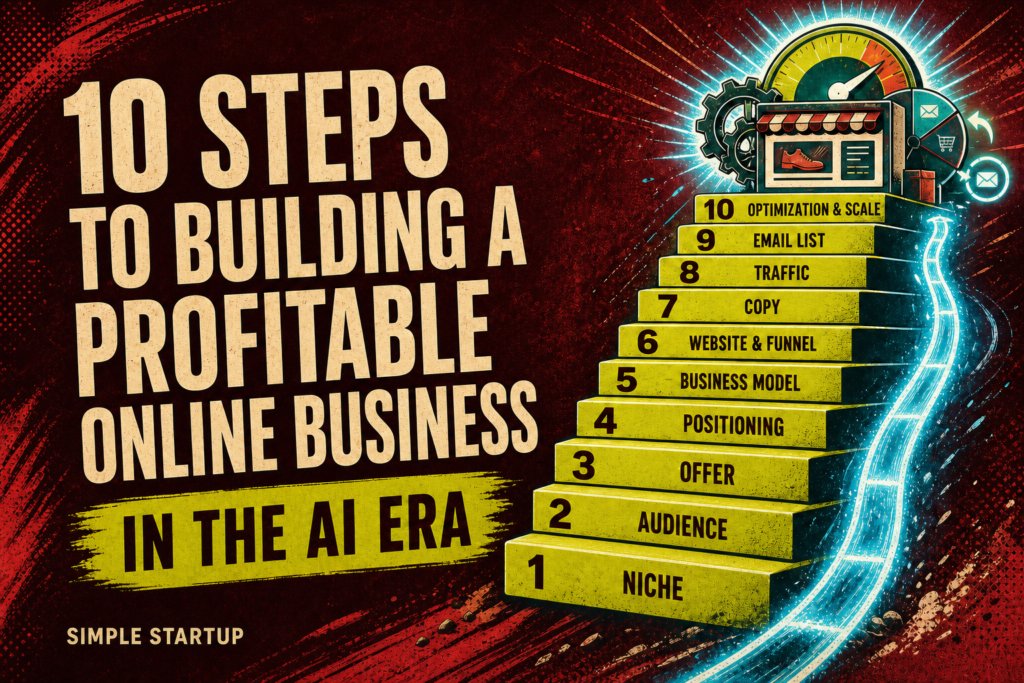
So here’s the full path, updated for how it actually works now. Ten steps, in order. Where I’ve written a deep dive on a step, I’ll point you to it… this post is the map, those are the territories.
The Short Answer
To build a profitable online business in the AI era: find a problem people already pay to solve, get to know one specific customer, put your plan on one page, sell your offer by hand before you build it, position it so the right people instantly get it, build one landing page (not a website), wire an email machine that runs while you sleep, publish content that gets found by Google and AI, write like a human, and only then automate and scale.
AI accelerates every step. It replaces none of them.
1. Find a Problem People Already Pay to Solve
Most aspiring founders pick a topic they like, build something, and hope. That order is backwards, and it’s the number one reason online businesses die quietly.
Niches are discovered, not chosen. That was true a decade ago and it’s true now. The difference: discovery used to take weeks of manual research. Now you can map a niche in an afternoon… ask ChatGPT or Claude what people in a space complain about, scan Amazon reviews for the phrase “I wish this book covered,” read the questions people actually type into Reddit and forums.
But here’s the part AI can’t do for you: confirming that people pay.
Look for evidence of money changing hands. Courses that keep relaunching. Books with hundreds of reviews. Freelancers charging real rates for the skill. Competition isn’t a bad sign… it’s proof of a market. No competition usually means no customers.
Start where your judgment already lives. The overlap of “I know this,” “people struggle with this,” and “people pay to fix this” is your niche.
2. Know Your One Customer Uncomfortably Well
Not a demographic. A person.
The test I use: could you recognize them in a coffee shop conversation? “Adults 25-54 interested in business” fails that test. “The burned-out project manager who wants to coach on the side, and is currently watching free YouTube videos instead of buying anything” passes.
The method hasn’t changed in a decade: talk to five to ten real people. Ask about their fears, frustrations, and what they’ve already tried. Write down the exact words they use… those words become your headlines later.
What’s new: you’ll be tempted to skip this step because AI can generate a customer avatar in ten seconds. Don’t. A generated avatar is a guess wearing a suit. The real conversations are where you hear the sentence you couldn’t have invented, and that sentence is worth more than any persona document.
3. Put Your Whole Plan on One Page
Not forty pages. Nobody reads forty pages, including the person who wrote them… and now that ChatGPT can generate a 40-page business plan in ninety seconds, the long version is worth exactly what it costs to produce: nothing.
One page. A handful of uncomfortable questions: who, what problem, what offer, what proof, which channel, what price. Twenty minutes of honest answers beats a quarter of planning theater.
I’ve written the full guide to the business plan for solopreneurs, with my own real answers filled in as the worked example. The one-page canvas from that post is the exact tool I use.
Then use AI the right way: don’t ask it to write your plan. Ask it to attack your plan. Paste in your one page and have it play a skeptical investor… find the weakest box, and design the cheapest test to check it.
4. Craft One Offer… and Sell It by Hand First
One thing. One price. For the person from Step 2.
And before you build anything (before the course exists, before the logo, before the website): sell it manually. A DM, an email, a call. Offer the thing, name the price, and watch what happens.
The first manual sale teaches you more than the next six steps combined. So does the first honest “no.” Deliver it yourself, watch where it wobbles, fold what you learn back into the offer.
This is the step every guru glosses over, because “I sold it awkwardly over email before it existed” makes a worse story than “I built a funnel and woke up rich.” But it’s the step that separates a business from an expensive hobby. A reader who completes every other step on this list without asking a human for money hasn’t started a business yet.
5. Position It So the Right People Instantly Get It
Your USP answers one question: “why should I buy from you instead of the obvious alternative… or instead of doing nothing?”
“We’re better quality” is not an answer. Specific is the answer. The classic example still teaches it best: Domino’s didn’t say “good pizza, delivered.” They said “fresh hot pizza delivered in 30 minutes or less, or it’s free.” A time, a promise, a guarantee. You can feel the difference.
In the AI era there’s a second reason positioning matters: when everyone can produce everything, the only thing that can’t be copied overnight is a position in your customer’s head. I’ve gone deep on this in my guide to positioning strategies for digital product creators… it’s the difference between two customers and two thousand.
6. Build One Page, Not a Website
This step used to say: build a website with seven pages, hire a designer, pick a premium theme.
Forget all of that for now.
You need one landing page with one job: explain the offer, collect the email. That’s it. I build mine in WordPress with the Bricks builder and Claude drafts the copy before I touch it… but the tool matters far less than the restraint. Websites are where new founders go to hide from the scary part (Step 4) for six weeks.
The full website comes later, after the offer has survived contact with real customers. A profitable business with one page beats a beautiful ten-page site with no offer… every time.
7. Wire the Email Machine
Email is still the highest-leverage channel in online business, and it’s the only audience you own. Social platforms rent you their audience and change the terms whenever they like. Your list is yours.
The machine has two parts, and both can run while you sleep:
- The lead magnet… one free thing that solves one specific problem in under twenty minutes, offered on the exact post or page about that problem. I’ve broken down the lead magnet ideas that actually convert, grouped by the job they do, with the exact delivery chain I run (Contact Form 7 into FluentCRM, tag, automation, tracked link).
- The welcome sequence… a handful of short emails that deliver the magnet, tell your story, and make your offer once.
Then sign up for your own thing with a real email address. I found a broken redirect on mine that way once. It would have silently failed for every subscriber, forever.
8. Publish Content That Gets Found… by Google AND by AI
Traffic advice used to be “pick a platform and grind.” Still true. But the platform math changed.
Search didn’t die… it moved into the chat window. Your customers now ask Google, ChatGPT, and Perplexity the same questions, and the businesses that get cited are the ones publishing specific, experience-backed answers. This is the best news small sites have had in a decade: AI engines reward depth and receipts, not domain size. I’ve shown how small sites beat big brands in AI search, and what I learned when I asked ChatGPT to recommend a business like mine and it didn’t.
The play: one useful post a week, in your lane, answering questions your customer actually types. My full playbook is in SEO for solopreneurs.
Production is cheap now. Everyone’s publishing more. Which means generic content is worthless and your specific experience… your numbers, your failures, your receipts… is the whole game.
9. Write Like One Person Talking to One Person
Copy is still the multiplier on everything above. The best offer with weak copy loses to a decent offer with sharp copy, and that was true before AI and remains true after.
What changed: AI can now produce infinite competent-sounding words, which means competent-sounding words are worth nothing. What converts is the sentence that proves a human who understands the reader wrote it… the exact phrase from your Step 2 conversations, the number from your own results, the honest caveat a marketer would have cut.
Learn the fundamentals once; they don’t expire. Two books that taught me more than any course: The Copywriter’s Handbook by Bob Bly and Great Leads by Masterson and Forde. Then use AI as your drafting partner, not your ghostwriter: it produces the raw material, you make the decisions and add the parts only you know.
10. Automate the Busywork, Then Scale
Last step, deliberately last. Automate only what already works manually. Automating a broken process just breaks things faster.
But once something works… this is where the AI era genuinely changes the math. The old version of this step said “build a virtual team.” The 2026 version: one person with AI agents can run operations that used to need five salaries. My agents draft content, audit the site, wire funnels, and queue social posts in Buffer. I review everything and make every decision, in a few focused hours a day.
I’ve documented the whole setup in how I run a one-person business with AI, and the exact path for building one from zero in how to start a one-person business with AI.
Scaling then looks like this: more traffic to what converts, better conversion on what’s proven, a second offer only after the first one sells reliably. Boring, sequential, profitable.
Free fillable tool
Get the Simple Startup Canvas
Step 3, done for you: the one-page canvas I use for my own business, as a fill-in PDF… plus the AI pressure-test prompt from this post. Twenty honest minutes.
Plus one practical idea a week for your one-person business. No spam. Unsubscribe anytime.
Before you go… it’s free
Don’t just read the ten steps. Do Step 3 tonight.
Grab the Simple Startup Canvas: your whole plan on one page, fillable and free. You could have version 1 done in twenty minutes.
One practical idea a week. No spam. Unsubscribe anytime.
The Part Worth Remembering
Read the list again and notice what’s NOT on it. No fundraising. No hiring. No office. No permission.
That was always the promise of an online business. For most of the last two decades it was only half true… the steps were simple, but executing all ten alone meant working like a team of five. Most people burned out somewhere around step 7.
That’s the part that quietly changed. The steps are the same. The stamina they demand is not.
One person, ten steps, a few focused hours a day. The profitable online business was never a secret… it was a workload. And the workload just became carryable.
Start with Step 1 this week: find one problem people already pay to solve. Twenty minutes of honest research. That’s the whole assignment.
And if you want the tools I use at every step, the Free Startup Toolkit has the templates and AI workflows that run this business.
FAQ
Can you still build a profitable online business in 2026?
Yes… arguably more easily than ever, because AI removed the workload that used to require a team. What hasn’t changed: you still need a real problem, a real customer, and an offer someone pays for. AI accelerates every step but replaces none of them.
How much does it cost to build a profitable online business?
Less than most people expect. A domain, hosting, an email tool, and an AI subscription… realistically under $100 a month for the whole stack. The real cost is consistent time: a few focused hours a day for months, not a weekend.
How long does it take to become profitable?
It depends on your offer and your consistency, but the honest range for a one-person digital business is months, not days. The fastest route is the order above: sell one offer manually first (Step 4), then build the machine around what already sells.
What’s the most profitable type of online business to start?
For one person: digital products and productized services built on judgment you already have… courses, templates, coaching, consulting. High margins, no inventory, and AI handles the production busywork. The “best” model is the one attached to a problem your specific customer already pays to solve.
Do you need a team to scale an online business?
Not anymore, for most knowledge and digital-product businesses. AI agents now cover the work that used to justify the first several hires: content production, email operations, research, site upkeep. You still make the decisions. One person plus AI is a real operating model… it’s how I run this business.