I’m going to be straight with you… you don’t need another shiny tactic. You need buyers who show up ready to act. That’s why I’ve been paying close attention to AI Search Optimization — also called Generative Engine Optimization (GEO) or Answer Engine Optimization (AEO).
This isn’t just hype. It’s about ranking in AI search engines like Google’s AI Overviews, ChatGPT, and Perplexity. When you get this right, you’re not just driving random traffic; you’re attracting high-converting AI SEO traffic. In the wild, teams are reporting conversion rates up to about 4x higher than standard organic clicks.
Here’s the kicker. Traditional SEO strategies already cover most of the work. Schema. Backlinks. Clear, structured content. Transactional keywords. The fundamentals. Then a few extra moves tilt the game in your favor and help you actually show up when AI generates answers.
In this guide, I’ll show you how AI search ranking really works, how to optimize your content for citations, and why this matters for SaaS founders, local service businesses, and e-commerce. You’ll get real AI SEO case studies, a 30-day GEO sprint you can copy, and practical strategies you can run today.
What Is GEO (Generative Engine Optimization) in AI Search?
At its core, GEO (short for Generative Engine Optimization) is about showing up when people ask AI tools for answers. That’s it. If you want the formal definition, researchers recently documented it here: GEO: Generative Engine Optimization.
For years, the game was ranking on Google. Someone typed “best CRM for agencies” and the goal was to land on that first page of blue links. Today, the same question gets asked inside AI search experiences like Google’s AI Overviews and similar tools that summarize results. If you’re curious how AI Overviews are changing search, this explainer is useful: Google AI Overviews: Everything you need to know.
Instead of a long list of links, the user often gets one direct answer with only a handful of sources mentioned. GEO is about making sure your business is one of those sources. If someone asks, “What’s the best mobile-first CRM for small creative agencies?” and the AI delivers a short list, you want your name there. These searchers are usually deep in research and much closer to taking action.
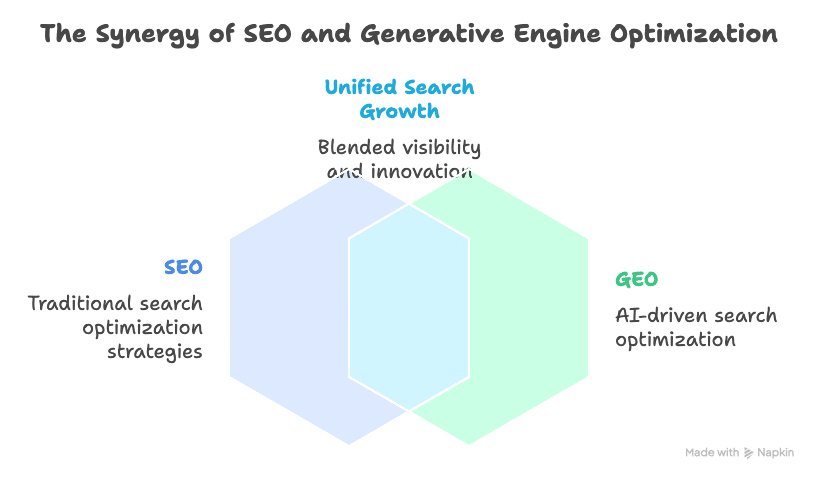
That’s the real power of GEO. It isn’t a trend for trend’s sake. It’s about being present in the answers when potential customers are already searching for solutions. And the good news is GEO isn’t totally new; it builds on SEO. The fundamentals still matter: clear content, structured data (Google docs), backlinks, and trust. The difference is that AI engines condense information, so your content needs to be straightforward, credible, and easy for them to cite.
Is AI Search Optimization Worth It or Just Hype?
The short answer is both. There’s hype around AI search in marketing circles, and there’s real substance behind it.
First, Google search isn’t going anywhere. Google now processes more than 5 trillion searches per year, which gives you a sense of the baseline demand: Google sees 5+ trillion searches annually.
At the same time, AI-driven search is growing. Google’s AI Overviews have been rolling out and evolving, which means more answers appear in summary form with limited citations. For context on what’s changing and how links are handled, see: Google AI Overviews: Everything you need to know.
So it’s not either/or. Both are growing in parallel. The noise usually comes from model and feature updates that can shift referral traffic quickly. That’s why the smart move is to treat AI Search Optimization as a layer on top of your SEO. Keep doing the fundamentals that build authority, then make it easy for AI systems to cite you. That way you’re visible whether someone lands on a classic results page or an AI-generated overview.
How AI Search Engines Rank and Cite Content
Here’s the process in plain English:
- A user asks a question in an AI search engine.
- The model fans the question into many variants.
- It searches those variants on engines like Google and Bing.
- It scrapes the top results; usually page one to three.
- It composes an answer and cites sources.
If your brand isn’t on those scraped pages, you won’t be included. That’s why GEO feels like a surface-area game. The more credible pages that include you, the higher your odds of being cited.
How to Identify Pages AI Engines Pull From
Use an AI search tracking tool to generate queries and capture which URLs appear in AI-generated answers. The output is your pages-to-target list. Your real work is outreach. Get included on those pages with value, not spam.
The tool matters less than the principle: collect the URLs models cite for your buyer’s queries, then earn your way onto those exact pages.
AI SEO Content Strategy: Writing to Be Cited
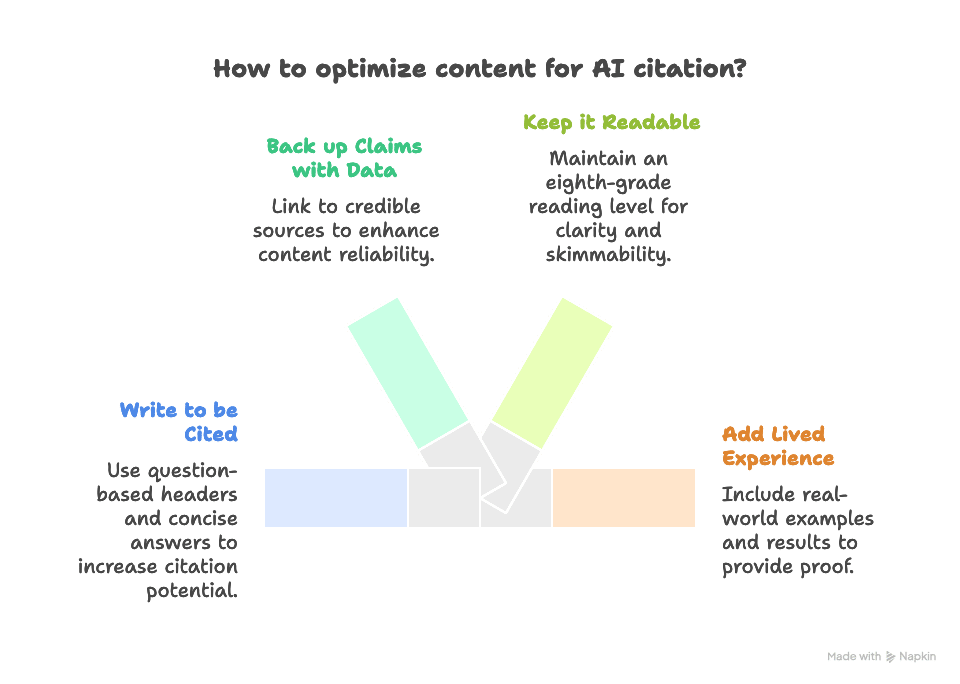
If you want your content cited inside AI answers, do four things:
- Write to be cited. Add H2 or H3 headers that are literally the questions people ask; place a crisp, two-sentence answer directly under the header.
- Back up claims with data. Link to credible sources. Example: instead of “kids who brush more get fewer cavities,” cite a reliable overview on twice-daily brushing and carries risk.
- Keep it readable. Eighth-grade reading level wins. Not “dumbed down”… just clean, simple, and skimmable.
- Add lived experience. Share customer examples, screenshots, actual results. AI can’t generate your real-world proof; models like citing it.
Technical SEO for AI Search: Schema, llms.txt, Crawl Access
When people talk about technical SEO for AI search, it can sound like dry checklists and acronyms. In reality, there are only a few things you need to get right — and they make a huge difference when it comes to whether AI models even notice your site. Let’s break it down in plain English.
- Structured data (schema). Think of schema as a translator between your website and AI search engines. It tells the model, “This page is about a service,” or “Here’s a product with reviews, pricing, and availability.” Without it, your site is just another blob of text. With it, you’re giving AI the exact cues it needs to use your content in an answer. You can test your site with Google’s Rich Results tool and see if the important pages — like your product or service pages — have schema applied.
- llms.txt for new or small sites. If your site is brand new, it’s like a stranger walking into a crowded room. Nobody knows who you are yet. An llms.txt file (introduced in 2025) is a simple way to highlight your most important pages for AI crawlers. Tools like Yoast make it almost a one-click process. It’s not magic, but it shortens the time it takes for AI systems to figure out what your site is about.
- Don’t block AI crawlers. This one sounds obvious, but it trips people up. Services like Cloudflare now give you the option to block AI bots by default. If you accidentally keep those settings on, models like ChatGPT or Perplexity won’t even see your site. Double-check in your Cloudflare dashboard that your important pages are open for crawling.
- Agent-friendly actions. AI agents are already being used to “act” on behalf of users — booking appointments, filling out forms, even running small workflows. If an agent can’t submit your lead form, view pricing, or add a product to the cart, you’ll never be recommended. Run a quick audit of your own site: can a bot (or even a friend who’s never seen your site before) complete the main call-to-action without friction? If not, fix that before you worry about the latest ranking hack.

Why Marketers Are Obsessed with GEO
There’s a reason every growth marketer I know is suddenly talking about GEO. It boils down to three things:
- Conversion quality. The people who find you through AI search aren’t casual browsers. They’ve already done their homework, and by the time they land on your site they’re close to pulling out their wallet. That’s why conversion rates can be 2x, 3x, even 4x higher than what you’d expect from traditional SEO traffic.
- Speed. Anyone who’s been in SEO knows it usually feels like a slow burn. You publish content, wait months, build links, and hope you climb. GEO flips that. If you land on the right listicles or comparison pages and those pages are cited by models, you can start seeing results in a matter of days.
- Land grab energy. If you’ve ever wished you got into SEO earlier, this is your chance. GEO feels like the early 2010s all over again — messy, unproven, but full of upside for the people who move first.
If you want to hear a grounded take, Greg Isenberg’s interview with Cody Schneider explains how this actually plays out for real companies (watch here).
Backlinks, Mentions, and Trust Signals for AI SEO
At the end of the day, AI search engines are trying to figure out who they can trust. They look at the same signals Google has been using for years, but through the lens of generating quick, credible answers. Here’s what matters most:
- Backlinks. Still the gold standard. If authoritative sites link to you, that’s a trust vote. You can earn them the hard way — through PR, guest posts, or expert contributions — or buy them carefully. The key is relevance. A backlink from a respected SaaS blog carries way more weight than ten random links from low-quality sites.
- Mentions. You don’t always need a hyperlink. If your brand keeps popping up on trusted pages, forums, or reviews, AI models notice. Think of it like reputation in the real world: if your name comes up often in the right rooms, people start to believe you belong there.
- Social proof. It’s not just about what Google or ChatGPT see on a page. If your product is being discussed in communities, shared on social, or included in “best of” roundups, editors keep adding you. Those mentions feed the cycle, and AI models pick up on the momentum.
Put simply: the more credible your footprint across the web, the more likely AI search engines are to use your content in their answers.
Why Transactional Keywords Drive AI Search Conversions
“How to” posts are still useful for authority, yet they often get summarized upstream by AI Overviews. If you want revenue, focus more energy on transactional keywords — the kind that map to buying intent.
The classic mistake is one giant services page with anchor links. Break services into dedicated pages. “Emergency plumber” deserves its own page. So does “water heater installation” or “custom glass for architects.” Purpose-built pages match buyer intent and tend to get cited more by models.
AI SEO Case Study: From Zero To GEO Traffic In 30 Days
Let’s make this real. Imagine you and I are launching a focused SaaS called FlowForge CRM. It’s built for small creative agencies that care about mobile-first pipelines and reporting. You already have a decent landing page, a comparison page, and a couple of customer stories. Traffic is light. Conversions are fine, but not life-changing. You want GEO to become a reliable assist; not the entire offense. Here’s how I’d run the 30-day sprint.
Week 1: Map Demand, Seed Queries, Pull The URL Universe
Step 1: Define the buyer and the intent.
Write this on a sticky note: “Small creative agencies; mobile-first CRM; wants easy import; willing to switch in 30 days; hates complex onboarding.” Short, specific, useful.
Step 2: Seed 30 to 50 “researcher” queries.
Mix commercial intent with feature intent and objection intent.
- “best CRM for small creative agencies 2025”
- “mobile first CRM for interior design studios”
- “easiest CRM to migrate from HubSpot for agencies”
- “CRM with client approvals and file comments”
- “affordable CRM for boutique agency under 10 seats”
- “HubSpot alternative for creative agencies”
- “Pipedrive vs [category] for creative teams”
- “top CRMs that integrate with Notion and Figma”
Step 3: Feed those into an AI-search tracker.
Use a tracker that does two things. First, generate synthetic variants of your seeds; the tool will fan out to hundreds of long queries. Second, collect the URLs being cited by ChatGPT, Perplexity, and friends. You want exports by query, by model, and by frequency.
Deliverable by Friday: a CSV with 3,000 to 10,000 rows. Columns to include: query, model, url, domain, position_in_answer, frequency, page_type (listicle, comparison, docs, community), contact_status, placement_status, price, affiliate_terms, notes.
SEO tip: Work “AI search tracking,” “GEO URLs,” and “AI citations” into the copy of the landing page where you’ll later summarize this sprint.
Week 2: Prioritize, Pitch, Place
Step 4: Collapse the long tail into a power list.
Sort by frequency, then by page_type. You’ll notice patterns. The same 80 to 150 URLs appear again and again. That is your Power 150.
- 40 to 60 listicles like “Top 10 CRMs for Agencies”
- 20 to 30 comparison posts like “HubSpot vs Pipedrive vs …”
- 10 to 15 analyst roundups on niche SaaS blogs
- 10 to 20 community pages and tool directories
- A handful of high authority editorial sites
Step 5: Research the editors and authors.
For each URL, find the person who can actually add you. Sometimes it’s an editor; sometimes the founder; sometimes a freelance writer who updates “best tools” posts quarterly. Create columns for contact_name, contact_email, X/Twitter, LinkedIn, update_cadence.
Step 6: Pitch with value; not just a “link ask.”
Make it embarrassingly easy to include FlowForge. Two templates you can use today.
Template A: Soft pitch with update angle
Subject: Quick update for your “Best CRM for Agencies” guide
Hi {Name},
I was reading your {post_title}. Great breakdown; I liked how you grouped by team size.
I built FlowForge CRM for small creative studios that live on mobile. Two fast things that might help readers:
- 12-minute import from HubSpot or CSV; no consultant required.
- Mobile pipeline with client comment approvals; agencies use it on shoots and during handoffs.
If you’re updating the post, I can send a one-pager with screenshots, pricing, and three short customer quotes. If it helps your business, I’m happy to offer a tracked affiliate link at {x}% and a custom landing page so readers get 14 days free plus priority onboarding.
Would that be useful?
{Your Name}
Template B: Value-first with custom assets
Subject: Free mini comparison for your readers
Hi {Name},
I pulled anonymized switching data from 217 small agencies that moved from HubSpot and Pipedrive to FlowForge in the last 6 months. I turned it into a clean comparison chart that your audience might appreciate. No gate, no email.
If you’d like, I can tailor a version of your “Best Agency CRMs” post with a side-by-side that matches your formatting. No fee asked. If it earns its keep, we can talk affiliate terms later.
Want a peek?
{Your Name}
Pricing reality check.
Expect numbers like $300 to $800 for an inclusion on a high-intent listicle. You can reduce out-of-pocket by sweetening affiliate terms. A good starting point is 30 to 40 percent of first month MRR; then step down to 10 to 20 percent for months two to six. If your LTV is healthy, this pencils out. If it doesn’t, you learned something important about price and payback.
SEO tip: Use UTM parameters that include geo, ai-search, listicle, and the domain so your analytics can attribute results clearly.
Week 3: Execution, Tracking, Iteration
Step 7: Deliver assets fast.
When someone says yes, send a tidy package within 24 hours. Keep it light; keep it useful.
- 90-word product blurb
- 3 benefits written for their audience
- 1 customer quote with a name and company
- 2 screenshots; one hero, one mobile pipeline
- Your logo in SVG and PNG
- Your UTM link, plus an affiliate link if you agreed to one
- A custom landing page URL with their logo in the hero subhead
Step 8: Track the impact.
Use UTMs like utm_source=site&utm_medium=geo&utm_campaign=listicle. Build a Looker Studio or Plausible dashboard showing sessions, trials, activations, and paid conversions from each placement. Add “first_seen_in_model” and “lift_after_placement” columns to your sheet. You want to see when your brand starts appearing in AI answers more often.
Step 9: Close the loop.
After a week, send a friendly update with numbers. If a partner sees your inclusion drives real signups, they keep you in the next version of the article. Relationships compound.
SEO tip: Publish a short “FlowForge GEO Update” blog once a month; summarize learnings and link out to the highest-impact placements. This helps internal linking and gives editors a reason to keep you included.
Week 4: Compounding Surface Area
Step 10: Fill the gaps you noticed.
You’ll see patterns. Maybe every comparison post mentions “Notion integration,” and your site barely mentions it. Fix that. Ship a Notion integration page; write a short playbook; add a quick video. Tie it back to the pages models scrape.
Step 11: Widen to adjacent intents.
Once your Power 150 is underway, expand to intent families like “client approvals in CRM,” “mobile pipeline for photo studios,” “CRM with visual Kanban for agencies,” “HubSpot migration tool for small teams.” Rerun the tracker; repeat outreach.
Step 12: Build one anchor asset per quarter.
AI respects authority that Google respects. Publish a data-driven piece with real numbers. Example: “217 Agency Switches: The Hidden Costs That Force CRM Migrations.” Offer a downloadable CSV of anonymized data. Your odds of organic citations go up; your odds of appearing in answers go up too.
The Numbers: A Hypothetical Outcome You Can Benchmark
Let’s keep it honest and useful. A realistic 30-day snapshot for FlowForge based on 40 active outreach conversations:
- Outreach sent: 120 emails
- Replies: 48
- Agree to include: 18
- Published within 30 days: 12
- Average fee per inclusion: $420
- Gross spend: $5,040
- Affiliate terms: 35 percent first month, 15 percent months two to six
- Traffic from placements in 30 days: 2,600 sessions
- Trials started: 364 (14.0 percent)
- Activated users: 210 (57.7 percent of trials)
- Paid conversions inside 30 days: 58
- ARPU month one: $38
- Month-one revenue from GEO placements: $2,204
- Projected six-month revenue at 20 percent monthly churn: roughly $8,500 to $10,500
- Blended payback window: about 60 to 90 days if placements persist and model inclusion increases
SEO tip: Publish this as a case study with a clean URL structure: /case-studies/flowforge-ai-search-optimization/. Include the words AI search optimization, GEO, and case study in the H1 and subheads.
AI Search SEO for Local Businesses: North Shore Roofing
Not everyone runs SaaS. Picture North Shore Roofing serving three suburbs. Ticket sizes are high. Buyers research for days. Trust is everything.
Queries to seed.
- “best roofing company in {Suburb} 2025”
- “roof leak emergency {Suburb} who to call”
- “metal roof vs asphalt lifespan in {City} climate”
- “financing options for new roof {Province}”
- “insurance roof replacement process {City}”
Power pages to target.
- Local news “best of” lists that refresh yearly
- Real estate blogs with service directories
- Homeowner association resource pages
- City Reddit wiki pages and curated threads
- Trade associations that maintain vendor pages
- “Top 10 roofing companies” listicles on regional blogs
Offer value.
- A short PDF buyer’s guide: “Is It Repair Or Replace? A 15 Minute Roof Decision Guide.”
- A quote calculator embedded on your site; linkable from their page.
- A same-day photo inspection service with a shared link; editors love concrete offers.
Measure reality.
- Track phone calls and form submissions with local UTM links.
- Ask every new caller: “How did you find us?” Log “AI chat” when they say “I asked Perplexity” or “I asked ChatGPT.”
- Keep a sheet: placement date, UTM sessions, booked inspections, closed jobs, job value. Small sample sizes are fine; you want direction.
Outcome you can expect.
Five or six placements can be enough in a mid-sized city. If two of those are on pages models cite often, mentions start to rise. Even ten new jobs at an average invoice of $7,500 changes your year.
SEO tip: Build separate service pages per suburb and per service. Titles like “Emergency Roof Repair in {Suburb}” and “Metal Roofing Installation in {Suburb}” help you rank in both Google Maps and AI Overviews.
AI Search Optimization for E-Commerce: Atelier Finch
Now let’s zoom into a brand with a point of view. Call it Atelier Finch, a menswear label that cares about fabric provenance and timeless cuts. It isn’t cheap; it isn’t for everyone. That’s the point.
Queries to seed.
- “best men’s oxford shirt brands with long staple cotton”
- “minimalist menswear brands with ethical factories”
- “Japanese selvedge denim brands like {X} but cheaper”
- “heritage knitwear brands that ship to Canada”
Power pages to target.
- Editorial listicles on style magazines
- Niche menswear blogs with “capsule wardrobe” posts
- Reddit sidebars and wikis in r/malefashionadvice and r/rawdenim
- European boutique directories with brand indexes
Value move.
- Offer a short factory tour video and fabric spec sheet that editors can embed.
- Provide exact measurements and shrinkage tests in a static table; models love structured facts.
- Partner with two respected micro-creators to write a “how it wears after 12 months” review. Real patina. Real photos.
Result pattern.
Volume will be lower than SaaS or local services; AOV will be higher. If you get onto five to eight editorial lists that AI frequently cites, expect a small but steady trickle of buyer-ready visitors. Treat this as a brand trust engine, not a flash sale channel.
SEO tip: Create data-rich product spec pages with tables the models can parse: fiber length, GSM, weave, shrinkage after 3 washes. Add an evergreen “Care & Fit Guide” that internal links across your catalog.
A Simple AI SEO SOP for Your Team
Inputs: seed queries, one tracking tool login, one spreadsheet, one writer, one partnerships lead.
Daily rhythm.
- Pull newly cited URLs from the tool; append to the sheet.
- Enrich with contact names and emails.
- Send 10 tailored pitches before lunch.
- After lunch, assemble asset packs for every yes.
- Log UTMs; update conversion metrics.
- End of day, post three learnings in a running doc.
Weekly rhythm.
- Monday: re-rank the Power 150 by frequency; reassign five that slipped.
- Wednesday: fix one content gap you noticed.
- Friday: send two partner updates with early numbers; ask what would make your inclusion more helpful.
SEO tip: Publish a monthly “What We Learned About AI Search” roundup. Long-tail queries like AI search ranking factors 2025 or GEO case study results can pick up traffic and internal links strengthen your cluster.
Pitfalls That Quietly Kill GEO Results
- Chasing vanity domains instead of frequently cited niche blogs.
- Sending generic blurbs; editors ignore boilerplate.
- Dumping users on a generic homepage; match the promise from the listicle.
- Ignoring product gaps competitors highlight.
- Over-rotating into GEO and starving your core SEO or partnerships.
Quick ROI Formula for AI SEO Placements
Before you pay for inclusion, run this in your head:
Expected monthly sessions from the page
× click-through rate to your link
× site conversion rate
× month-one ARPU.
If the number is half or more of the fee, and the page tends to stick six months or more, it’s probably worth testing. Sweeten with affiliate terms and you improve the odds.
30-Day GEO Sprint Checklist
- 30 to 50 seed queries written from the buyer’s point of view
- One tracker set up; exports enabled by model and frequency
- Power 150 list created and ranked
- Contact names and emails enriched
- Two pitch templates customized to your voice
- Asset pack ready: 90-word blurb, 3 benefits, 2 screenshots, 1 quote, logo, UTM link, custom landing page
- Dashboard live: sessions, trials, activations, paid conversions by placement
- Two content gaps fixed that models clearly value
- Two partner updates sent with early numbers
- One anchor asset scoped for next quarter
FAQs on AI Search Optimization
How fast can I see results?
Often within 2 to 7 days, depending on crawl cycles and model refresh cadence.
Is paying for inclusion harmful?
Not if the page is high quality and relevant. You also gain a backlink. Keep it ethical.
What if a model update wipes my mentions?
It happens. Keep building placements; keep your SEO solid; keep relationships warm. Treat GEO as a durable channel that fluctuates.
Do I need an affiliate program?
It helps. Editors run businesses; give them a clean, tracked way to win with you.
Final Thoughts: AI Search Optimization Is an “And,” Not an “Or”
You don’t need a big team to make GEO work. You don’t need to toss your SEO playbook. You need focus. A clear buyer. A system you can repeat every day.
Start small. Seed five queries. Run them through a tracker. Export the top twenty-five URLs. Send two pitches today.
Stack those moves. Ten emails a day. One small asset. One new partner. GEO stops feeling like hype… it starts to feel like momentum.
Because at the end of the day, this isn’t about acronyms. It’s about showing up when buyers ask, “What’s the best option?” and making sure your name is in the answer.